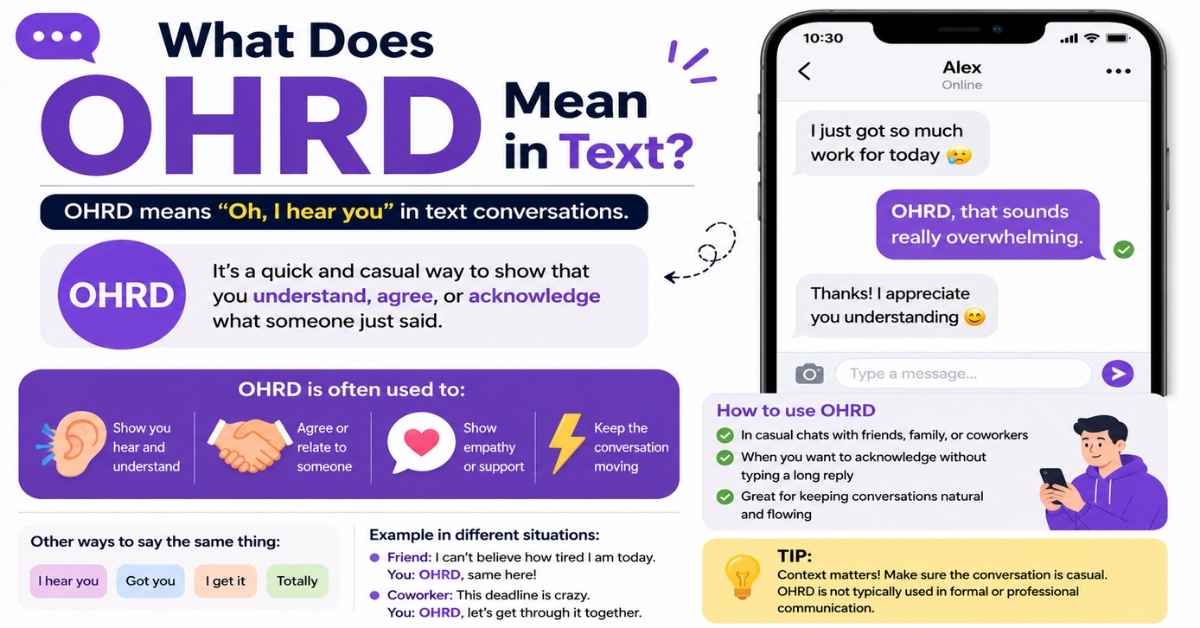
What does ohrd mean in text? OHRD usually means “Oh, Alright” or “Oh, Heard” in texting and online conversations. People use it as a casual way to acknowledge a message, show they understand what someone said, or agree before moving on. You’ll often see OHRD on Snapchat, TikTok, Instagram, Discord, WhatsApp, and other messaging apps where short internet slang is common.
If you’ve received “ohrd” in a text message and wondered whether it’s friendly, rude, or simply another way of saying “okay,” this guide explains everything. You’ll learn what OHRD meaning in text is, where it came from, how people use it on social media, and how to respond naturally in different situations.
What Does OHRD Mean in Text?
The OHRD meaning in text is most commonly “Oh, Alright.” It’s an internet slang expression used to acknowledge what another person has said. Depending on the conversation, it can also mean “Oh, Heard,” which is another way of saying “I understand” or “I got it.”
Unlike formal language, OHRD is an informal texting abbreviation that makes conversations faster and more relaxed. Instead of typing a full response like “Okay, I understand,” someone might simply reply with “ohrd.”
Quick Definition
| Term | Meaning | Tone |
|---|---|---|
| OHRD | Oh, Alright | Casual |
| OHRD | Oh, Heard | Understanding |
| OHRD | Got it / Okay | Neutral |
| OHRD | I understand what you mean | Friendly |
In most conversations, OHRD isn’t negative. It simply acknowledges the other person’s message without adding a long reply.
How People Commonly Use OHRD
People use OHRD in many everyday situations, such as:
- Confirming they understand a message.
- Agreeing with someone’s plans.
- Ending a conversation politely.
- Responding quickly in group chats.
- Keeping a casual conversation moving.
For example:
Friend: I’m running about 15 minutes late.
You: Ohrd.
Here, OHRD simply means “Okay, I understand.”
What Does OHRD Stand For?
Many people search “What does OHRD stand for?” because they assume it’s a traditional acronym. In reality, OHRD is more of a slang spelling than a formal abbreviation.
Oh, Alright
The most accepted meaning is “Oh, Alright.”
People use it when they acknowledge information, accept someone’s explanation, or agree with what has been said.
Example:
Person A: We’re meeting at 7 tonight.
Person B: Ohrd, I’ll be there.
In this case, the reply shows agreement and understanding.
Oh, Heard
Another popular interpretation is “Oh, Heard.”
In urban slang, saying “heard” means “I understand” or “I got your message.” Adding “Oh” creates the shortened texting form OHRD, which feels natural in casual conversations.
Example:
Friend: The event got canceled because of the rain.
You: Ohrd.
This tells the sender you received and understood the information.
Other Possible Meanings
Outside of texting, OHRD can appear as an acronym for organizations or departments. However, if you’re searching “what does ohrd mean in text messages,” those definitions usually don’t apply.
In text messaging, social media, gaming chats, and online conversations, OHRD almost always refers to the slang meaning, not an official acronym.
Where Did OHRD Come From?
Like many modern internet slang terms, OHRD developed naturally through spoken language before becoming popular online.
Origin of the Slang
The word comes from people casually pronouncing “Oh, Alright” very quickly in everyday speech. Over time, that pronunciation became written as “ohrd.”
Instead of carefully spelling every word, users began typing the shortened version to save time while texting.
Philadelphia and Baltimore Influence
Many language experts and online slang communities associate OHRD with Philadelphia and Baltimore, where expressions like “ard” (meaning alright) are commonly used in casual speech.
As these regional expressions spread through social media, millions of users adopted them in text messages and online chats.
How OHRD Became Popular Online
Several platforms helped OHRD become part of modern digital communication:
- Snapchat
- TikTok
- Discord
- Facebook Messenger
- Online gaming communities
Short replies work well on these platforms because they keep conversations quick and informal.
What Does OHRD Mean on Different Platforms?
Although the spelling stays the same, the meaning of OHRD can feel slightly different depending on where it’s used.
OHRD on Snapchat
On Snapchat, OHRD usually means:
- Okay
- I understand
- Got it
Since Snapchat conversations are often brief, users prefer quick acknowledgments over long replies.
Example:
Friend: I’ll snap you later.
Reply: Ohrd.
OHRD on TikTok
On TikTok, people often use OHRD in comments or replies after agreeing with someone’s opinion.
Example:
“That actually makes sense.”
“Ohrd.”
Here, it simply shows agreement.
OHRD on Instagram
On Instagram, you’ll find OHRD in direct messages and comment sections.
It often means:
- I agree
- Okay
- I see your point
- Makes sense
OHRD on WhatsApp
In WhatsApp conversations, OHRD usually replaces longer responses like:
- Okay
- Sounds good
- Got it
- Understood
Because WhatsApp is primarily used for chatting with friends and family, this casual expression feels natural.
OHRD on Discord
Gamers and online communities frequently use OHRD on Discord when confirming instructions or acknowledging teammates.
Example:
Leader: Attack from the left side.
Player: Ohrd.
The reply confirms they understood the plan.
OHRD on Facebook Messenger
On Messenger, OHRD functions much like “okay” or “I hear you.”
It’s a quick response that keeps the conversation moving without sounding overly formal.
OHRD on X (Twitter)
On X, users often reply OHRD to tweets when they agree with a statement or acknowledge new information.
Depending on the context, it may also carry a slightly sarcastic tone, so it’s always important to consider the rest of the conversation.
OHRD in Gaming Chats
Fast-paced online games encourage short communication.
Players use OHRD because it’s faster than typing:
- I understand.
- Okay.
- Got it.
- Sounds good.
This makes it a common part of gaming chat slang and online messaging.
Key Takeaway: OHRD is a casual internet slang term that most commonly means “Oh, Alright” or “Oh, Heard.” Whether you’re using Snapchat, TikTok, Instagram, Discord, WhatsApp, or gaming chats, it generally expresses understanding, agreement, or acknowledgment. However, its exact tone depends on the conversation and the relationship between the people chatting.
Is OHRD Positive, Negative, or Rude?
One of the most common questions people ask after learning the OHRD meaning in text is whether it’s friendly, neutral, or rude. The short answer is that OHRD isn’t inherently rude. Its meaning depends on the conversation, the relationship between the people chatting, and the tone of the messages before it.
In most text messages, OHRD simply means “Okay,” “I understand,” or “Got it.” However, because it’s such a short reply, some people may interpret it differently if there’s little context.
Friendly Meaning
Most of the time, OHRD is used in a friendly and relaxed way. It lets the other person know you’ve understood what they said without needing a long response.
Example:
Friend: We’re grabbing pizza after work.
You: Ohrd, see you then.
Here, OHRD shows agreement and keeps the conversation casual.
Neutral Meaning
Sometimes OHRD is simply an acknowledgment with no strong emotion attached. It’s similar to replying with “Okay” or “Sounds good.”
Example:
Person: The meeting has been moved to Friday.
Reply: Ohrd.
There’s no excitement or frustration—just confirmation that the message has been received.
Can OHRD Sound Rude?
Although OHRD usually has a neutral meaning, it can sound dismissive if it’s the only response to a serious or emotional message.
Example:
Friend: I’m really upset about what happened today.
Reply: Ohrd.
In this situation, the response may seem cold because it doesn’t acknowledge the person’s feelings. A more thoughtful reply would be more appropriate.
Can OHRD Be Passive-Aggressive?
Yes, but only in certain situations.
Like many internet slang expressions, OHRD can take on a passive-aggressive tone depending on the conversation.
Example:
Person A: You never replied to my messages yesterday.
Person B: Ohrd.
Here, the reply may suggest indifference or annoyance. However, the word itself isn’t negative—it’s the surrounding context that creates that impression.
How Context Changes the Meaning
The same word can express different emotions depending on how it’s used.
| Conversation | Meaning of OHRD |
|---|---|
| Friend making plans | Okay, sounds good |
| Receiving information | I understand |
| Group chat | Got it |
| Ending a conversation | Alright, talk later |
| Serious discussion | May feel dismissive if used alone |
Remember: Never judge the meaning of OHRD without reading the entire conversation.
How to Use OHRD in Text Messages
Understanding how to use OHRD in texting helps you communicate naturally while avoiding misunderstandings.
Because it’s an informal texting abbreviation, OHRD works best in casual conversations rather than professional settings.
Casual Conversations
Friends often use OHRD instead of writing:
- Okay
- Got it
- Sounds good
- I understand
- Alright
Example:
Friend: I’ll call you after dinner.
You: Ohrd.
Chats With Friends
When chatting with close friends, OHRD feels natural because everyone understands the informal tone.
Example:
Friend: I’m staying home tonight.
You: Ohrd, maybe tomorrow then.
Group Chats
In busy group chats, people prefer short replies to avoid unnecessary messages.
Example:
Group Admin: Everyone meet online at 8 PM.
Members: Ohrd.
The response quickly confirms everyone has seen the message.
Romantic Conversations
You can use OHRD with someone you’re close to, but avoid using it when they expect emotional support.
Good Example:
Partner: I’ll be home around 7.
You: Ohrd ❤️
Poor Example:
Partner: I’m feeling really stressed today.
You: Ohrd.
The second reply may seem uncaring because it lacks empathy.
Gaming Chats
Online games require fast communication, making OHRD a useful response.
Example:
Team Leader: Defend the base.
Player: Ohrd.
When You Should Avoid Using OHRD
Although OHRD is common in online messaging, it isn’t appropriate everywhere.
Avoid using it:
- In professional emails.
- During job interviews.
- When speaking to clients.
- In formal business communication.
- When someone is sharing personal or emotional news.
In these situations, writing a complete response shows respect and professionalism.
Real Examples of OHRD in Conversations
The easiest way to understand the OHRD meaning in text messages is through real-life examples.
Example 1: Friendly Chat
Alex: Movie starts at 8.
Jordan: Ohrd, I’ll be there.
Meaning: Agreement.
Example 2: Receiving Information
Chris: School is closed tomorrow.
Taylor: Ohrd.
Meaning: I understand.
Example 3: Group Conversation
Admin: Please submit your reports by Friday.
Member: Ohrd.
Meaning: Message received.
Example 4: Casual Conversation
Friend: I’m going to the gym after work.
Reply: Ohrd, have fun.
Meaning: Sounds good.
Example 5: Gaming Chat
Captain: Stay together this round.
Player: Ohrd.
Meaning: Understood.
Example 6: Slightly Annoyed Response
Person A: I forgot to bring your book again.
Person B: Ohrd.
Depending on the conversation, this could suggest disappointment or frustration, even though the word itself remains neutral.
LEARN MORE: OM Meaning Text
How to Reply to OHRD
Many users searching “what does OHRD mean in text” also want to know how to respond.
Fortunately, replying is simple because OHRD usually indicates the other person understands your message.
If Someone Is Agreeing
There’s often no need to continue the conversation unless you have something else to add.
Example:
You: Meet me outside in five minutes.
Friend: Ohrd.
Your response could simply be:
“See you soon!”
If They Sound Upset
If the conversation feels tense, don’t assume OHRD is rude. Ask a polite follow-up question.
Example:
“Everything okay?”
This helps clear up misunderstandings.
–
If They’re Ending the Conversation
Sometimes OHRD simply means the conversation is wrapping up.
You can reply with:
- Talk later.
- Sounds good.
- See you tomorrow.
- Have a great day.
If You’re Unsure of Their Tone
Instead of guessing, look at:
- Previous messages.
- Emojis.
- The topic being discussed.
- Your relationship with the sender.
Context almost always explains the intended meaning better than the word itself.
Quick Tip: If you’re unsure whether OHRD means “Okay,” “I understand,” or something more dismissive, focus on the overall conversation rather than the abbreviation alone.
OHRD vs Similar Texting Slang
Many internet slang terms look similar but have different meanings. Understanding these differences helps you avoid confusion in text messages and online conversations.
| Slang | Meaning | When It’s Used |
|---|---|---|
| OHRD | Oh, Alright / Oh, Heard | Acknowledgment, agreement |
| ARD | Alright | Casual confirmation |
| RD | Alright | Shortened version of ARD |
| OK | Okay | Universal acknowledgment |
| BET | Sounds good / Deal | Accepting plans or agreeing |
| AIGHT | Alright | Informal agreement |
| HEARD | I understand | Acknowledging information |
OHRD vs ARD
Both mean “Alright,” but OHRD often implies you’ve processed or acknowledged new information, while ARD is simply another way to say “alright.”
OHRD vs RD
RD is an even shorter variation of ARD. Both are common in casual texting and social media slang.
OHRD vs OK
OK works in both formal and informal communication. OHRD is better suited to casual chats with friends.
OHRD vs BET
BET usually expresses excitement or agreement with a plan.
Example:
“Let’s meet tonight.”
“Bet!”
Meanwhile, OHRD focuses more on acknowledging or understanding the message.
OHRD vs AIGHT
Both are informal alternatives to “Alright,” but AIGHT is more common in spoken English, while OHRD appears more frequently in texting and online messaging.
OHRD vs HEARD
HEARD directly means “I understand.” OHRD combines that idea with a conversational “Oh,” making it feel more relaxed and natural in text conversations.
Who Uses OHRD the Most?
Although OHRD isn’t as common as slang like LOL or BRB, it’s widely recognized in casual texting, social media, and online messaging. It’s especially popular among younger users who prefer quick, informal responses.
Gen Z
Gen Z uses OHRD frequently because it’s short, easy to type, and fits the fast-paced style of modern conversations on Snapchat, TikTok, Instagram, and Discord.
Instead of typing:
“Okay, I understand.”
Many simply reply:
“Ohrd.”
Millennials
Many Millennials also use OHRD, especially if they’re active on social media or gaming platforms. However, some may still prefer replying with “OK,” “Got it,” or “Sounds good.”
Social Media Users
You’ll often spot OHRD in:
- Snapchat chats
- TikTok comments
- Instagram DMs
- Facebook Messenger
- WhatsApp conversations
- X (formerly Twitter) replies
- Discord servers
- Reddit discussions
It’s used as a quick acknowledgment rather than a full sentence.
Gamers
Gamers appreciate short replies that don’t interrupt gameplay.
For example:
Squad Leader: Watch the right side.
Player: Ohrd.
This confirms the instruction without slowing down communication.
Common Misunderstandings About OHRD
Because OHRD is an internet slang term, many people misunderstand what it means. Here are the most common misconceptions.
It Doesn’t Always Mean “Okay”
While OHRD often translates to “Okay”, it can also mean:
- I understand.
- Got it.
- Oh, alright.
- Message received.
The exact meaning depends on the conversation.
It Isn’t Always Rude
Some people assume a one-word reply is unfriendly. In reality, OHRD is usually neutral.
If someone regularly sends short messages, OHRD is probably just their texting style.
Tone Depends on Context
The same word can express different emotions depending on the situation.
Example 1
Friend: I’ll be there in five minutes.
Reply: Ohrd.
Meaning: Friendly acknowledgment.
Example 2
Friend: I’m really disappointed.
Reply: Ohrd.
Here, the response may seem insensitive because the conversation called for empathy.
Not Every OHRD Means the Same Thing
Some people use OHRD to end a conversation.
Others use it simply to acknowledge information.
That’s why context is more important than the word itself.
Tip: Always read the messages before and after OHRD before deciding what the sender meant.
When Should You Use OHRD?
Using OHRD correctly helps your messages sound natural without creating confusion.
Appropriate Situations
You can safely use OHRD when:
- Talking with friends.
- Chatting in group messages.
- Responding on Snapchat.
- Messaging on Discord.
- Playing online games.
- Replying on TikTok or Instagram.
Situations to Avoid
Avoid using OHRD in:
- Job applications.
- Professional emails.
- Business conversations.
- Academic writing.
- Customer support messages.
- Formal requests.
In professional communication, complete sentences create a better impression.
Professional vs Casual Messaging
| Casual Chat | Professional Chat |
|---|---|
| Ohrd | Understood. |
| Bet | Certainly. |
| Aight | Alright. |
| LOL | Thank you for letting me know. |
Choosing the right tone shows respect for your audience.
Is OHRD an Acronym or Just Slang?
This question often appears because OHRD is written in capital letters.
The answer is both, depending on the context.
In text messages, Snapchat, TikTok, WhatsApp, and Discord, OHRD is considered internet slang, representing phrases like “Oh, Alright” or “Oh, Heard.”
Outside texting, OHRD may also stand for organization names or department titles. However, those meanings are unrelated to casual online conversations.
If you’re searching “what does ohrd mean in text,” you’re almost certainly looking for the slang meaning.
Why Do People Say OHRD Instead of Okay?
Language changes constantly, especially online.
People choose OHRD because it feels:
- Faster to type.
- More casual.
- More expressive than simply saying OK.
- Common in internet culture.
- Popular among younger users.
Just as people use LOL, BRB, IDK, FR, or NGL, OHRD has become another shortcut in modern digital communication.
LEARN MORE: TD Meaning Text
How to Pronounce OHRD
Many people who first see OHRD aren’t sure how to say it.
The easiest pronunciation is:
“Oh-ard.”
It sounds similar to saying:
“Oh, alright.”
Since it’s mostly used in text messages, pronunciation isn’t as important as understanding its meaning.
Quick Comparison Table
| Question | Answer |
|---|---|
| What does OHRD mean in text? | Oh, Alright or Oh, Heard |
| Is OHRD slang? | Yes |
| Is OHRD rude? | Usually no |
| Is OHRD positive? | Generally yes |
| Where is OHRD used? | Snapchat, TikTok, Instagram, WhatsApp, Discord, Messenger |
| Is it formal? | No |
| Can it end a conversation? | Sometimes |
| Should you use it at work? | Not recommended |
Frequently Asked Questions
What does OHRD mean in text?
OHRD usually means “Oh, Alright” or “Oh, Heard.” It’s a casual slang term used to show understanding, agreement, or acknowledgment in text messages and online chats.
Is OHRD rude?
No. OHRD is generally a neutral or friendly response. It may only seem rude if it’s used alone during an emotional or serious conversation.
What does OHRD mean on Snapchat?
On Snapchat, OHRD usually means “Okay,” “Got it,” or “I understand.”
What does OHRD mean on TikTok?
On TikTok, it’s commonly used in comments and replies to acknowledge someone’s opinion or agree with what they said.
Is OHRD the same as ARD?
Not exactly. ARD simply means “Alright,” while OHRD often carries the added meaning of “Oh, I understand” or “Message received.”
Can I use OHRD in professional conversations?
No. Since OHRD is informal slang, it’s better to use complete responses like “Understood,” “Certainly,” or “Thank you for the update” in professional settings.
What does OHRD mean from a girl or a guy?
The meaning is the same regardless of who sends it. It usually indicates acknowledgment or agreement. The tone depends on the conversation rather than the sender’s gender.
Does OHRD end a conversation?
Sometimes. In many chats, OHRD serves as a final acknowledgment, signaling there isn’t anything else to add.
Key Takeaways
- OHRD most commonly means “Oh, Alright” or “Oh, Heard.”
- It’s a popular internet slang term used in text messages, Snapchat, TikTok, Instagram, Discord, WhatsApp, and other messaging platforms.
- In most situations, it expresses agreement, understanding, or acknowledgment rather than frustration or rudeness.
- The tone of OHRD depends on context, so always consider the rest of the conversation before interpreting its meaning.
- While it’s perfect for casual chats, it’s best avoided in professional or formal communication.
Final Thought: If someone sends you “OHRD,” they’re usually just saying “Okay,” “I understand,” or “Got it.” Understanding the context, tone, and platform where it’s used will help you interpret the message correctly and respond naturally.