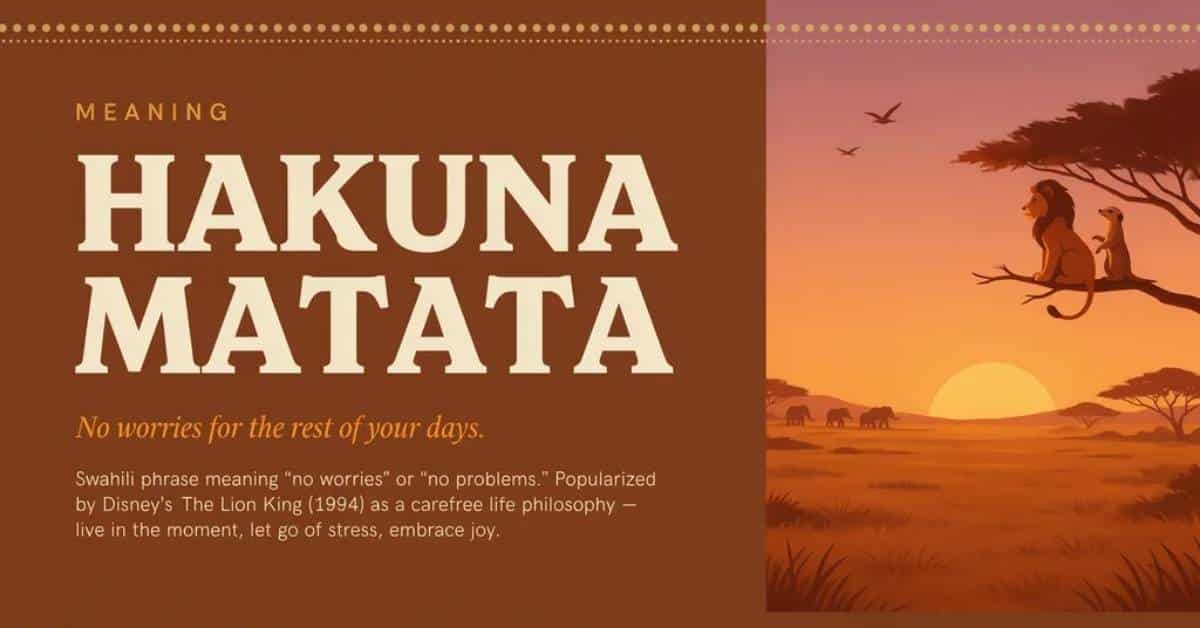
Hakuna matata meaning is “there are no problems” or, more naturally in English, “no worries” or “don’t worry.” The phrase comes from the Swahili language, which is widely spoken across East Africa, particularly in Kenya and Tanzania. Although millions of people recognize it from Disney’s The Lion King, Hakuna Matata has been part of everyday Swahili conversations long before the movie introduced it to a global audience.
Whether you’re curious about hakuna matata meaning in English, hakuna matata meaning Swahili, or want to know its cultural significance beyond Disney, this guide explains everything in simple terms. You’ll also learn its pronunciation, origin, real-life usage, translations in different languages, and common misconceptions.
Quick Answer: What Does Hakuna Matata Mean?
Hakuna Matata is a Swahili phrase that literally translates to “there are no problems.” In everyday English, it is commonly understood as “no worries,” “don’t worry,” or “everything is okay.” It expresses reassurance, optimism, and the idea of not letting life’s small challenges cause unnecessary stress.
Why “Hakuna Matata” Is More Than Just “No Worries”
Many people assume Hakuna Matata is simply another way of saying “no worries.” While that’s correct in casual conversation, the phrase carries a deeper cultural meaning.
In East African culture, it reflects a calm and positive approach to life’s everyday difficulties. Rather than ignoring problems, it encourages people to stay composed and avoid unnecessary anxiety. This relaxed mindset is one reason the phrase resonates with people worldwide.
Its popularity skyrocketed after Disney featured it in The Lion King, but its roots remain firmly connected to Swahili-speaking communities.
What Does Hakuna Matata Mean?
Literal Meaning of Hakuna Matata
The phrase consists of two Swahili words:
| Swahili Word | Literal Meaning | Practical Meaning |
|---|---|---|
| Hakuna | There is not / There are no | No |
| Matata | Problems, troubles | Worries or difficulties |
When combined, Hakuna Matata literally means:
“There are no problems.”
This literal translation forms the foundation for its more familiar English interpretation.
Everyday Meaning in English
In everyday conversations, Hakuna Matata meaning in English can be expressed as:
- No worries
- Don’t worry
- Everything is fine
- No problem
- It’s all okay
The exact translation depends on the situation, but all convey reassurance and positivity.
Why There Isn’t One Perfect English Translation
Languages rarely translate word for word. Swahili expressions often carry emotional and cultural nuances that don’t fit perfectly into English.
For example:
- Literal: There are no problems.
- Natural English: No worries.
- Conversational: Everything will be okay.
This is why different dictionaries and language experts may provide slightly different translations while preserving the same overall meaning.
Hakuna Matata Meaning in Different Languages
Although Hakuna Matata is a Swahili phrase, many people search for its meaning in other languages. The emotional message remains largely the same, even though each language has its own way of expressing it.
Hakuna Matata Meaning in English
In English, the closest translations are:
- No worries
- No problem
- Don’t worry
- Everything is okay
These expressions capture the reassuring tone of the original phrase rather than providing a strict word-for-word translation.
Hakuna Matata Meaning Swahili
Hakuna Matata meaning Swahili is literally:
“There are no problems.”
In everyday Swahili conversations, the phrase is used to comfort someone or reassure them that everything is under control.
Hakuna Matata Meaning in African
Many people search for hakuna matata meaning in African, but it’s important to clarify that Africa is a continent, not a single language.
The phrase belongs specifically to the Swahili language, spoken across several East African countries. While people throughout Africa may recognize it because of its popularity, it is not a phrase used universally across all African languages.
Hakuna Matata Meaning in Hindi
In Hindi, the closest meanings include:
- कोई चिंता नहीं
- सब ठीक है
- फिक्र मत करो
These expressions communicate the same reassuring message.
Hakuna Matata Meaning Korean
The closest Korean equivalents include phrases meaning:
- Don’t worry.
- Everything is fine.
- No problem.
Rather than translating each word literally, Korean uses natural conversational expressions with the same intent.
Hakuna Matata Meaning in Japanese
In Japanese, similar meanings include:
- Don’t worry.
- It’s okay.
- No problem.
Again, the focus is on conveying reassurance rather than matching each Swahili word exactly.
Hakuna Matata Meaning in Zulu
Zulu doesn’t use the exact phrase Hakuna Matata, but similar expressions communicate ideas like:
- No worries.
- Everything is alright.
- Don’t stress.
Although the wording differs, the emotional message is very similar.
Does the Phrase Have the Same Emotional Meaning Across Languages?
Yes. While each language expresses reassurance differently, the core idea remains remarkably consistent:
- Stay calm.
- Don’t panic.
- Everything will be okay.
- There’s no need to worry.
This universal message explains why Hakuna Matata has become one of the world’s most recognizable foreign-language expressions.
Which Language Is Hakuna Matata From?
Hakuna Matata comes from Swahili, one of Africa’s most widely spoken languages.
Swahili belongs to the Bantu language family and serves as a common language for millions of people across East Africa.
Where Is Swahili Spoken?
Swahili is widely spoken in:
- Kenya
- Tanzania
- Uganda
- Democratic Republic of the Congo
- Parts of Rwanda
- Burundi
- Mozambique
- Other East African regions
Because it functions as a regional language, many people speak Swahili alongside their native local languages.
Is Hakuna Matata Used Every Day?
Yes—but not constantly.
Native speakers may use Hakuna Matata when reassuring someone after a minor inconvenience, expressing that everything is under control, or encouraging someone to relax.
Depending on the region and context, locals may also use similar expressions that convey the same meaning.
Word-by-Word Breakdown of Hakuna Matata
Understanding each word makes the phrase much easier to remember.
| Word | Meaning | Role |
|---|---|---|
| Hakuna | There is not / There are no | Negative expression |
| Matata | Problems or troubles | Noun |
Together, they create one simple but meaningful sentence:
Hakuna Matata = There are no problems.
This straightforward structure is one reason the phrase is easy for learners around the world to understand.
How to Pronounce Hakuna Matata Correctly
Correct pronunciation helps you use the phrase naturally and respectfully.
Phonetic Pronunciation
Ha-KOO-nah Ma-TAH-tah
Each vowel is pronounced clearly, unlike in English where some vowels become silent.
Syllable Breakdown
Ha – Koo – Na
Ma – Ta – Ta
Speak each syllable smoothly without rushing.
Common Pronunciation Mistakes
Many English speakers mistakenly:
- Stress the wrong syllables.
- Shorten the vowel sounds.
- Merge words too quickly.
Instead, pronounce each syllable evenly and clearly. Swahili pronunciation is generally consistent, making it easier to learn than many other languages.
By understanding not only the translation but also the pronunciation and linguistic structure, you’ll appreciate why Hakuna Matata remains one of the most meaningful and widely recognized Swahili phrases around the world.
The Origin and History of Hakuna Matata
The story behind Hakuna Matata is much older than many people realize. Although the phrase became internationally famous through Disney’s The Lion King in 1994, it has been part of the Swahili language for generations.
Swahili developed through centuries of trade along the East African coast, where African, Arab, Persian, and later European influences helped shape the language. Today, it serves as a lingua franca for millions of people across East Africa, allowing speakers from different ethnic groups to communicate easily.
Within this linguistic tradition, Hakuna Matata naturally evolved as a reassuring expression used in everyday conversations.
Historical Use Before Disney
Long before Hollywood introduced the phrase to the world, people in Kenya, Tanzania, and neighboring regions used Hakuna Matata to comfort family members, friends, colleagues, and travelers.
Someone might say it after:
- A minor mistake
- A delayed appointment
- An unexpected inconvenience
- A stressful moment
Rather than dismissing someone’s concerns, the phrase gently communicates:
“It’s okay. Don’t let this trouble you.”
This practical, optimistic attitude explains why the phrase became so relatable across cultures.
Traditional Swahili Usage
Unlike many popular expressions that originate from movies or songs, Hakuna Matata has authentic linguistic roots.
Native Swahili speakers use it naturally in situations involving reassurance and encouragement. Depending on the region and conversation, speakers may also choose other expressions with similar meanings, but Hakuna Matata remains one of the most widely recognized.
Cultural Background
In East African culture, conversations often emphasize politeness, hospitality, and maintaining positive relationships.
The phrase reflects these values by encouraging calmness rather than panic. It doesn’t suggest ignoring serious problems. Instead, it reminds people not to become overwhelmed by everyday challenges.
This cultural perspective helps explain why the phrase resonates far beyond its literal translation.
How the Phrase Spread Worldwide
Although travelers had encountered the phrase long before, its global popularity increased dramatically after Disney released The Lion King.
The memorable song introduced millions of viewers to Hakuna Matata, transforming it from a regional Swahili expression into one of the world’s best-known foreign-language phrases.
Today, you’ll find it on:
- Travel souvenirs
- Clothing
- Wall art
- Books
- Music
- Social media captions
- Inspirational quotes
Its worldwide appeal demonstrates how language can cross cultural boundaries while still preserving its original meaning.
How Disney’s The Lion King Made Hakuna Matata Famous
For many people outside Africa, the first encounter with Hakuna Matata came through Disney’s animated classic.
In the film, Timon and Pumbaa teach Simba to adopt a carefree outlook after difficult experiences. Their catchy song helped transform the phrase into a global symbol of optimism.
Why Disney Chose the Phrase
Disney selected Hakuna Matata because it perfectly reflected the personalities of Timon and Pumbaa.
The phrase is:
- Easy to pronounce
- Memorable
- Positive
- Universally appealing
Its cheerful message fit naturally into the film’s storyline while introducing audiences to a genuine Swahili expression.
Is Disney’s Translation Accurate?
Yes—with a small clarification.
Disney translated Hakuna Matata as “No worries.”
Although this isn’t the most literal translation, it accurately captures the phrase’s intended meaning in everyday conversation.
A closer literal translation would be:
“There are no problems.”
Both versions communicate reassurance, making Disney’s interpretation appropriate for the film.
Trademark Controversy Explained
Over the years, some people questioned Disney’s trademark registration related to the phrase, arguing that Hakuna Matata had existed in Swahili long before the movie.
It’s important to understand that trademark registrations generally apply to specific commercial uses, such as merchandise, rather than ownership of the language itself.
The phrase itself remains an authentic part of the Swahili language and East African cultural heritage.
How Native Swahili Speakers Actually Use Hakuna Matata
One reason many articles fall short is that they rarely explain how people genuinely use the phrase in daily life.
Understanding the context makes the expression much more meaningful.
Everyday Conversations
A friend arrives late because of traffic.
Instead of becoming upset, someone smiles and says:
“Hakuna Matata.”
The message is simple:
“It’s okay.”
No apology needs to become a major issue.
Tourist Situations
Visitors traveling through Kenya or Tanzania may hear guides, hotel staff, or local shopkeepers use the phrase when solving small problems.
Examples include:
- A delayed meal
- A schedule change
- A misplaced reservation
- Minor travel inconveniences
In these situations, Hakuna Matata reassures visitors that everything will be handled.
Friendly Conversations
Friends often use the expression after someone says:
- Sorry.
- I made a mistake.
- I’m worried.
- I forgot.
Instead of criticizing them, another person may simply reply:
Hakuna Matata.
This creates a relaxed and positive atmosphere.
Situations Where People Usually Don’t Say It
Although the phrase is comforting, native speakers don’t use it for every circumstance.
It isn’t generally appropriate when discussing:
- Serious illness
- Major financial hardship
- Family emergencies
- Natural disasters
- Significant personal loss
In these cases, more thoughtful and specific expressions are usually preferred.
Understanding this distinction helps travelers and language learners use the phrase respectfully.
Real-Life Examples of Hakuna Matata in Conversations
Seeing the phrase in context makes it much easier to understand.
Friends Talking
Ali: Sorry I’m late.
Sara: Hakuna Matata. We just started.
Meaning:
“No worries.”
At a Hotel
Guest: My room isn’t ready yet.
Receptionist: Hakuna Matata. It will be ready shortly.
Meaning:
“Everything is under control.”
During Travel
Traveler: I think I missed the bus.
Guide: Hakuna Matata. Another one will arrive soon.
Meaning:
“Don’t worry.”
Family Conversation
Child: I accidentally broke the cup.
Parent: Hakuna Matata. Accidents happen.
Meaning:
“It’s okay.”
These examples demonstrate that the phrase is used to reassure people rather than to ignore genuine problems.
Similar Swahili Expressions You Should Know
Learning related phrases helps you better understand everyday Swahili conversations.
| Expression | Meaning | Common Use |
|---|---|---|
| Hakuna Matata | No worries | Reassurance |
| Hamna Shida | No problem | Everyday conversations |
| Pole Pole | Slowly | Encouragement to take your time |
| Karibu | Welcome | Greeting guests |
| Asante Sana | Thank you very much | Expressing gratitude |
| Jambo | Hello | Friendly greeting |
Each phrase reflects the warmth and hospitality associated with Swahili-speaking communities.
Common Misconceptions About Hakuna Matata
Despite its popularity, several myths continue to circulate online.
Myth 1: Disney Invented Hakuna Matata
Fact: The phrase existed in Swahili long before The Lion King.
Myth 2: It Only Means “No Worries”
Fact: While “No worries” is the most common English translation, the literal meaning is “There are no problems.”
Myth 3: Everyone in Africa Speaks Swahili
Fact: Africa has thousands of languages. Swahili is one of the continent’s most widely spoken languages, but it is primarily associated with East Africa.
Myth 4: People Say Hakuna Matata All the Time
Fact: Native speakers certainly use the phrase, but they also use many other expressions depending on the situation, region, and level of formality.
Myth 5: It’s Appropriate in Every Situation
Fact: While encouraging and positive, Hakuna Matata isn’t suitable for every circumstance. Serious situations often call for more thoughtful responses.
Understanding these nuances allows you to appreciate the phrase not only as a famous movie quote but also as a meaningful part of Swahili language and culture.
When Should You Use Hakuna Matata?
Knowing what Hakuna Matata means is only part of the story. Using it in the right context shows respect for the language and the culture it comes from.
Appropriate Situations
You can naturally use Hakuna Matata when you want to reassure someone about a small or temporary problem.
Examples include:
- A friend apologizes for being a few minutes late.
- Someone accidentally spills a drink.
- A colleague worries about a minor mistake.
- A traveler experiences a small delay.
- A family member feels stressed over something unimportant.
In these situations, saying Hakuna Matata communicates kindness, reassurance, and optimism.
Situations to Avoid
Although the phrase promotes a positive outlook, it shouldn’t be used to dismiss serious concerns.
Avoid using it when someone is dealing with:
- A medical emergency
- The loss of a loved one
- Significant financial difficulties
- Serious mental or emotional distress
- Major personal hardships
In these circumstances, empathy and thoughtful support are far more appropriate than a casual expression.
Travel Etiquette Tips
If you’re visiting Kenya, Tanzania, or another Swahili-speaking region, using Hakuna Matata respectfully can create friendly interactions.
Keep these tips in mind:
- Pronounce it correctly.
- Use it naturally instead of repeating it excessively.
- Appreciate it as part of the local culture rather than a movie quote.
- Listen to how native speakers use it before incorporating it into conversations.
A genuine interest in the language is always appreciated more than relying on stereotypes.
Cultural Respect Guidelines
Remember that Hakuna Matata represents a real linguistic and cultural tradition.
While Disney helped popularize the phrase, its roots belong to generations of Swahili speakers. Understanding this background shows cultural awareness and helps preserve the expression’s authentic meaning.
LEARN MORE: Kouhai Meaning
Why Hakuna Matata Resonates Around the World
Very few foreign-language expressions become globally recognized, yet Hakuna Matata has achieved that status.
Its popularity isn’t simply because of a memorable song. The phrase expresses a universal feeling that people everywhere can relate to.
A Positive Mindset
Everyone experiences stress, uncertainty, and unexpected challenges.
The idea behind Hakuna Matata encourages people to face life’s minor setbacks with calmness rather than panic. That optimistic perspective appeals across cultures and generations.
Easy to Remember
The phrase has a simple rhythm and repeating vowel sounds, making it memorable even for people who don’t speak Swahili.
Its musical quality contributed to its popularity long before it became a familiar travel slogan or social media caption.
A Bridge Between Cultures
For many people, Hakuna Matata serves as their first introduction to the Swahili language.
This curiosity often inspires people to learn more about:
- East African cultures
- Swahili vocabulary
- Regional history
- Local traditions
- Travel destinations
In this way, one simple phrase becomes a gateway to a richer understanding of another culture.
A Message That Never Goes Out of Style
Life constantly presents new challenges, but the reminder to stay calm and focus on solutions remains timeless.
That’s why Hakuna Matata continues to appear in books, music, travel experiences, motivational content, and everyday conversations around the world.
Interesting Facts About Hakuna Matata
Here are a few fascinating facts you may not know:
- Hakuna Matata is an authentic Swahili phrase, not something invented for a movie.
- The literal translation is “There are no problems.”
- It became internationally famous after Disney’s The Lion King was released in 1994.
- Swahili is spoken by tens of millions of people across East Africa as both a native and second language.
- The phrase is commonly associated with Kenya and Tanzania, where Swahili is widely used.
- Its popularity has made it one of the world’s most recognizable expressions from an African language.
- Despite its fame, native speakers use many other Swahili expressions depending on the situation and region.
Frequently Asked Questions
What does Hakuna Matata literally mean?
The literal meaning of Hakuna Matata is “there are no problems.” In everyday English, it is usually translated as “no worries” or “don’t worry.”
Is Hakuna Matata a real Swahili phrase?
Yes. Hakuna Matata is a genuine expression in the Swahili language and has been used in East Africa for many years before becoming internationally famous.
Who created Hakuna Matata?
No individual created the phrase. It naturally developed within the Swahili language over generations and has long been part of everyday communication.
Did Disney invent Hakuna Matata?
No. Disney introduced the phrase to a global audience through The Lion King, but it did not invent it. The expression already existed in Swahili-speaking communities.
Is Hakuna Matata offensive?
No. In general, Hakuna Matata is a positive and respectful phrase. However, like any cultural expression, it should be used appropriately and with an understanding of its origins.
Is Hakuna Matata commonly used in Kenya and Tanzania?
Yes. People in Kenya and Tanzania recognize and use the phrase, although they also use many other expressions depending on the situation, dialect, and region.
How do you pronounce Hakuna Matata?
The standard pronunciation is:
Ha-KOO-nah Ma-TAH-tah
Each vowel is pronounced clearly, making it relatively easy for beginners to learn.
What is the response to Hakuna Matata?
There isn’t one fixed response. Depending on the conversation, people may simply smile, continue talking, or thank the speaker for the reassurance.
Is Hakuna Matata formal or informal?
The phrase is generally informal and best suited to relaxed, friendly conversations.
Why is Hakuna Matata famous?
Its worldwide popularity comes largely from Disney’s The Lion King, where it became the title of a memorable song. Even so, the phrase has authentic Swahili origins that predate the film.
Can tourists use Hakuna Matata?
Yes. Visitors can use the phrase respectfully, especially when they understand its pronunciation, meaning, and cultural background.
Key Takeaways
Before you go, here are the most important points to remember:
- Hakuna Matata meaning is “there are no problems,” commonly translated as “no worries.”
- The phrase comes from the Swahili language, not from a movie.
- It is widely associated with Kenya, Tanzania, and other East African regions.
- Disney helped make the phrase globally famous but did not create it.
- The expression is best used to reassure someone about minor concerns, not serious hardships.
- Understanding its cultural background helps you use it naturally and respectfully.
- Whether you’re exploring hakuna matata meaning in English, hakuna matata meaning Swahili, hakuna matata meaning in Hindi, hakuna matata meaning Korean, hakuna matata meaning in Japanese, hakuna matata meaning in Zulu, hakuna matata meaning in African, or hakuna matata meaning in different languages, the central message remains the same: stay calm, don’t worry, and focus on moving forward.
Conclusion
Hakuna Matata is much more than a famous movie quote. It is a meaningful Swahili expression rooted in the language and culture of East Africa, where it has been used for generations to offer reassurance and encouragement.
While its most familiar English translation is “no worries,” the phrase literally means “there are no problems.” That subtle difference highlights why understanding the cultural and linguistic context is just as important as knowing the translation itself.
Whether you discovered Hakuna Matata through The Lion King, while planning a trip to Kenya or Tanzania, or simply out of curiosity, its enduring popularity comes from a universal message that speaks to people everywhere. It reminds us to approach life’s everyday challenges with patience, optimism, and perspective—qualities that remain just as valuable today as they have always been.
The next time you hear Hakuna Matata, you’ll know it isn’t just a catchy phrase. It’s a timeless expression of reassurance, resilience, and the rich heritage of the Swahili language.