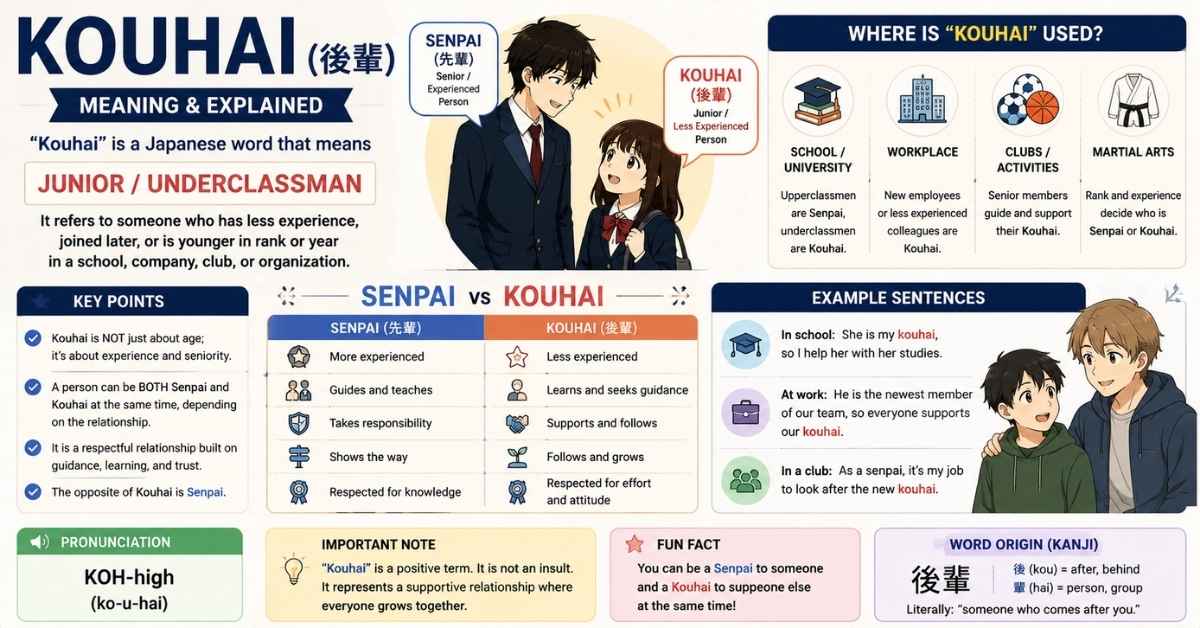
Kouhai meaning is “junior” in English, but the word carries a much deeper meaning in Japanese culture. A Kouhai is someone with less experience, lower seniority, or a later entry into a school, workplace, sports club, or organization. The opposite of a Kouhai is a Senpai, who is the more experienced senior. While many people first encounter the term through anime and manga, the Kouhai system is a real part of everyday life in Japan.
Whether you’re searching for kouhai meaning in English, kouhai meaning Japanese, senpai kouhai meaning, or kouhai meaning anime, this guide explains everything you need to know with practical examples, cultural insights, pronunciation tips, and real-life usage.
Quick Answer: What Does Kouhai Mean?
Kouhai (後輩) is a Japanese word that refers to a junior person within a relationship based on experience or seniority. A Kouhai may be a younger student, a newly hired employee, a less experienced athlete, or a newer member of a club. The relationship emphasizes respect, learning, guidance, and mutual responsibility rather than simply age.
| Term | Meaning |
|---|---|
| Kouhai (後輩) | Junior or less experienced person |
| Senpai (先輩) | Senior, mentor, or experienced person |
Why Understanding “Kouhai” Is About More Than Translation
At first glance, translating Kouhai as “junior” seems straightforward. However, this translation only captures part of its meaning.
In English-speaking cultures, a junior is often defined by age or job title. In Japan, Kouhai describes a social relationship built on experience, respect, and shared responsibility.
This relationship appears in:
- Schools
- Universities
- Companies
- Sports clubs
- Martial arts dojos
- Student organizations
It helps create structure while encouraging mentorship between experienced and newer members.
This is why understanding kouhai meaning Japanese requires learning about Japanese culture—not just vocabulary.
What Does Kouhai Mean?
The kouhai meaning goes beyond being “someone younger.”
A Kouhai is someone who joins a group after another person or has less experience within that organization.
For example:
- A first-year university student is the Kouhai of second-year students.
- A newly hired employee is the Kouhai of experienced coworkers.
- A beginner in a martial arts dojo becomes the Kouhai of senior practitioners.
Experience—not age—is usually the deciding factor.
Kouhai Meaning in English
The closest kouhai meaning in English includes:
- Junior
- Junior member
- Less experienced person
- Newcomer
Although these translations are useful, none fully express the cultural expectations attached to the Japanese term.
Unlike the English word junior, Kouhai often involves a learning relationship with a senior mentor.
Kouhai Meaning Japanese
In Japanese society, Kouhai represents more than status.
It reflects:
- Respect
- Learning
- Responsibility
- Guidance
- Personal growth
- Teamwork
The role encourages newer members to learn from those with greater experience while contributing positively to the group.
Why Kouhai Has No Perfect English Equivalent
Language reflects culture.
The English word junior usually describes someone’s position or age.
Kouhai, however, describes an ongoing relationship between people.
For example:
A 35-year-old employee who joins a company today may still be the Kouhai of a 25-year-old colleague who has worked there for several years.
This example highlights why experience, not age, defines the relationship.
How the Senpai–Kouhai Relationship Works
One of the most important concepts in Japanese culture is the Senpai–Kouhai relationship.
Understanding senpai kouhai meaning helps explain why both words are almost always discussed together.
What Is a Senpai?
A Senpai is the senior, mentor, or more experienced person within a group.
Their role often includes:
- Teaching newcomers
- Offering guidance
- Sharing knowledge
- Setting a positive example
- Supporting the team’s development
Being a Senpai isn’t simply about authority—it’s about responsibility.
What Is a Kouhai?
A Kouhai is the newer or less experienced member.
Typical expectations include:
- Learning from senior members
- Showing respect
- Asking thoughtful questions
- Working hard
- Supporting the group
Over time, today’s Kouhai often becomes tomorrow’s Senpai.
Responsibilities of a Senpai
Although expectations differ by organization, a Senpai often:
- Teaches procedures
- Introduces new members
- Answers questions
- Encourages improvement
- Provides constructive feedback
A good Senpai leads through patience rather than authority.
Responsibilities of a Kouhai
Likewise, a Kouhai is generally expected to:
- Listen carefully
- Learn quickly
- Respect experienced members
- Accept guidance
- Contribute to the team’s success
The relationship works best when both sides support one another.
Can Someone Be Both a Senpai and a Kouhai?
Yes.
This is one of the most misunderstood aspects of Japanese hierarchy.
Imagine a university student in their second year.
- They are the Senpai of first-year students.
- They are still the Kouhai of third- and fourth-year students.
The same applies in companies.
A department supervisor may be a Senpai to junior employees while remaining a Kouhai to senior managers.
The relationship depends on relative experience, not permanent status.
Where Is the Word Kouhai Used?
Many people believe Kouhai is only used in anime.
In reality, it appears in many areas of Japanese life.
Schools
Schools are where many students first experience the Senpai–Kouhai system.
Older students often:
- Help new students
- Share advice
- Explain school traditions
- Offer academic guidance
Universities
Japanese universities also maintain this tradition.
Senior students often mentor juniors by helping them:
- Choose courses
- Join clubs
- Prepare for internships
- Understand campus life
Workplaces
The system continues after graduation.
In many companies, experienced employees naturally guide new hires.
Although modern workplaces are becoming less formal, the concept remains influential.
Sports Clubs
Sports teams frequently emphasize respect between senior and junior members.
Experienced players may:
- Demonstrate techniques
- Lead practice sessions
- Encourage younger teammates
Martial Arts
Traditional martial arts schools continue to value the Senpai–Kouhai relationship.
Students learn not only physical skills but also discipline, humility, and mutual respect.
Student Organizations
Many student clubs also follow this structure.
New members learn traditions from experienced members before eventually passing that knowledge to future generations.
Kouhai Meaning Anime
One reason international audiences recognize the word is because of its frequent appearance in anime and manga.
Why Anime Uses Kouhai So Often
Anime often reflects everyday aspects of Japanese life.
School settings naturally include:
- First-year students
- Upperclassmen
- Clubs
- Sports teams
- Student councils
Because these environments follow the Senpai–Kouhai system, the terms appear frequently in dialogue.
Does Anime Represent Real Japanese Culture Accurately?
Generally, yes—but sometimes with exaggeration.
Anime often dramatizes relationships for storytelling purposes.
In real life:
- Most interactions are less formal.
- Relationships vary between organizations.
- Personality matters as much as hierarchy.
Nevertheless, the underlying Senpai–Kouhai concept is authentic and remains an important part of many Japanese schools, workplaces, and organizations.
How to Pronounce Kouhai Correctly
Correct pronunciation helps you understand and use the word naturally.
Phonetic Pronunciation
KOH-high
The first syllable rhymes with “go.”
The second sounds like the English word “high.”
Syllable Breakdown
Ko – u – hai
Speak each part smoothly without rushing the vowels.
Common Pronunciation Mistakes
Many beginners mistakenly:
- Pronounce it as “cow-high.”
- Ignore the long vowel sound.
- Stress the wrong syllable.
Listening to native speakers and repeating the pronunciation aloud is the best way to develop a natural accent.
By understanding the pronunciation alongside the cultural meaning, you’ll gain a much deeper appreciation for why Kouhai is one of the most recognizable and meaningful Japanese terms used both inside and outside Japan.
Enjo Kouhai Meaning
One search term that often confuses readers is enjo kouhai meaning.
Unlike Kouhai, Enjo Kouhai is not a standard Japanese word that you’ll commonly hear in everyday conversations. Instead, it appears occasionally in online communities, entertainment media, fan discussions, or as part of specific fictional works.
What Does Enjo Kouhai Mean?
The meaning of Enjo Kouhai depends entirely on the context in which it is used.
The phrase combines two Japanese words:
- Enjo (援助) – generally means support, assistance, or aid.
- Kouhai (後輩) – means junior or a less experienced member.
Depending on the source, Enjo Kouhai may loosely describe:
- A junior receiving support from a senior.
- A fictional character title.
- A phrase used in online communities or entertainment.
Because there is no universally accepted standalone definition, it’s important to interpret the phrase based on where you encountered it.
Why the Phrase Appears Online
Many people discover Enjo Kouhai through:
- Anime discussions
- Manga communities
- Social media
- Fan translations
- Gaming communities
Internet culture often combines Japanese words in creative ways that don’t always reflect everyday spoken Japanese.
Understanding the Context
Whenever you encounter Enjo Kouhai, ask yourself:
- Is it from an anime?
- Is it part of a game?
- Is it a manga title?
- Is it being used humorously online?
Understanding the source is the best way to interpret the phrase accurately.
Common Misunderstandings
Many readers assume Enjo Kouhai is a traditional Japanese social role similar to Senpai and Kouhai.
It is not.
The established cultural relationship is the Senpai–Kouhai system, while Enjo Kouhai depends heavily on the context in which it appears.
How Japanese People Actually Use Kouhai
One of the biggest shortcomings of many articles is that they define the word without showing how Japanese people actually use it.
Everyday Conversations
In schools and clubs, students may naturally refer to someone as their Kouhai.
Example:
Student A:
“She’s my Kouhai in the tennis club.”
This simply means she joined later or has less experience.
The relationship carries no negative meaning.
Workplace Communication
Companies also use the concept.
Example:
“Our newest employee is my Kouhai.”
This indicates professional seniority rather than age.
An older employee can still be someone’s Kouhai if they joined the company later.
Student Life
University students frequently mentor newer classmates.
Example:
“I helped my Kouhai prepare for the entrance ceremony.”
Here, the relationship reflects guidance and support rather than authority.
Club Activities
Japanese clubs often emphasize teamwork through the Senpai–Kouhai relationship.
Senior members teach:
- Club rules
- Practice routines
- Team traditions
- Competition etiquette
Meanwhile, Kouhai learn through observation and participation.
Real-Life Examples of Kouhai in Conversations
Understanding conversations makes the word much easier to remember.
School Example
Yuki:
Who’s the new student?
Hana:
She’s my Kouhai.
Meaning:
She joined after me and has less experience at school.
Office Example
Manager:
Could you help your Kouhai with today’s project?
Meaning:
Please mentor the newer employee.
Sports Team Example
Coach:
Experienced players should support their Kouhai during practice.
Meaning:
Senior athletes help newer teammates improve.
Anime Dialogue Example
Character A:
Please take care of our new Kouhai.
Meaning:
Help the junior member adjust to the group.
Although anime often dramatizes these relationships, the underlying idea closely reflects Japanese culture.
Kouhai vs. Senpai Comparison
Many readers search for senpai kouhai meaning because both words almost always appear together.
Understanding one requires understanding the other.
| Feature | Senpai | Kouhai |
|---|---|---|
| Experience | More experienced | Less experienced |
| Position | Senior member | Junior member |
| Responsibility | Guides others | Learns from seniors |
| Leadership | Often mentors | Receives guidance |
| Common Settings | Schools, companies, clubs | Schools, companies, clubs |
| Relationship | Supports juniors | Respects seniors |
The relationship isn’t based on power.
Instead, it encourages:
- Mutual respect
- Continuous learning
- Teamwork
- Personal growth
Common Myths About Kouhai
Because anime introduced the word to international audiences, many misconceptions have developed.
Myth 1: Kouhai Means Someone Younger
Fact:
Age isn’t the deciding factor.
A person can be older but still become someone’s Kouhai by joining a school, company, or organization later.
Myth 2: Kouhai Only Exists in Anime
Fact:
Anime popularized the word internationally, but the Senpai–Kouhai relationship is a genuine part of Japanese schools, workplaces, sports clubs, and many organizations.
Myth 3: Only Students Can Be Kouhai
Fact:
The relationship exists in:
- Companies
- Universities
- Sports teams
- Martial arts schools
- Volunteer organizations
- Community groups
Myth 4: Kouhai Is an Insult
Fact:
Not at all.
Being someone’s Kouhai simply indicates relative experience.
It doesn’t imply lower personal worth or social status.
Myth 5: Foreigners Should Never Use the Word
Fact:
Japanese language learners can certainly understand and occasionally use Kouhai in appropriate contexts.
However, it’s generally best to use the term naturally rather than forcing it into conversations where it doesn’t fit.
Respect for the culture is more important than using Japanese vocabulary unnecessarily.
When Does Someone Stop Being a Kouhai?
One question rarely answered by competitors is whether someone remains a Kouhai forever.
The answer depends on the relationship.
Imagine a university student.
- During first year, they are everyone’s Kouhai.
- During second year, they become a Senpai to first-year students while remaining a Kouhai to older students.
- By graduation, they may mentor many younger students.
The same pattern occurs in workplaces.
As careers progress, people naturally move between both roles.
This dynamic nature is one of the defining features of the Senpai–Kouhai system and explains why the relationship continues to shape teamwork, mentorship, and professional development throughout Japanese society.
When Should You Use the Word Kouhai?
Understanding kouhai meaning is one thing, but knowing when to use the word correctly is equally important.
Although Kouhai is a common term in Japan, it should always be used with an understanding of the relationship between the people involved.
Appropriate Situations
You can naturally use Kouhai when referring to someone who:
- Joined a school after you.
- Is newer to a workplace.
- Has less experience in a club or organization.
- Is learning under a more experienced member.
- Participates in a sports team or martial arts dojo where seniority is recognized.
In these situations, the word describes a relationship rather than judging a person’s ability.
Situations to Avoid
Avoid using Kouhai when:
- You don’t know whether the relationship actually exists.
- You’re speaking about cultures that don’t use the Senpai–Kouhai system.
- The person may misunderstand the cultural meaning.
- You’re assuming seniority based only on age.
Outside Japan, many people may not be familiar with the concept, so additional explanation may be helpful.
Cultural Etiquette Tips
If you’re learning Japanese or visiting Japan, remember these practical guidelines:
- Respect comes before titles.
- Don’t assume someone is your Kouhai simply because they appear younger.
- Observe how native speakers use the word.
- Use the term naturally rather than forcing it into conversations.
- Focus on understanding the relationship, not just memorizing the vocabulary.
These habits help you communicate respectfully and avoid common misunderstandings.
Advice for Japanese Learners
If you’re studying the Japanese language, think of Kouhai as more than a vocabulary word.
It represents a cultural concept built around:
- Respect
- Responsibility
- Mentorship
- Learning
- Mutual support
Understanding these values will help you appreciate many other aspects of Japanese communication and society.
LEARN MORE: Hakuna Matata Meaning
Why the Senpai–Kouhai System Matters in Japanese Culture
The Senpai–Kouhai relationship has influenced Japanese education, workplaces, sports, and community organizations for generations.
Its purpose isn’t to create unnecessary hierarchy but to encourage cooperation and knowledge sharing.
Respect
One of the core values of Japanese culture is showing respect for people with greater experience.
A Kouhai learns by observing, listening, and asking thoughtful questions, while a Senpai demonstrates patience and leadership.
Mentorship
Unlike many informal mentoring systems, the Senpai–Kouhai relationship often develops naturally through daily interactions.
Senior members help newcomers understand:
- Group expectations
- Procedures
- Traditions
- Best practices
This guidance makes it easier for new members to adapt.
Teamwork
Whether in a classroom, company, or sports club, the relationship encourages everyone to work toward shared goals.
As today’s Kouhai gain experience, they eventually become Senpai, continuing the cycle by supporting future generations.
Personal Growth
The relationship benefits both sides.
A Kouhai gains confidence through guidance, while a Senpai develops leadership, communication, and mentoring skills.
This mutual development is one reason the system remains relevant in many modern Japanese organizations.
Frequently Asked Questions
What does Kouhai mean?
Kouhai is a Japanese word meaning junior or less experienced person. It refers to someone who joins a school, workplace, club, or organization after another person and typically learns from a Senpai, or senior member.
What does Kouhai mean in English?
The closest kouhai meaning in English is “junior.” However, the Japanese word also conveys a relationship based on experience, mentorship, and respect, making it more nuanced than the English equivalent.
What is the difference between Senpai and Kouhai?
A Senpai is the more experienced or senior member of a group, while a Kouhai is the junior or less experienced member. The relationship is based on guidance, learning, and mutual respect rather than age alone.
Is Kouhai an honorific?
No. Kouhai is not an honorific like -san, -kun, or -chan. Instead, it describes a person’s role within a senior–junior relationship.
Is Kouhai respectful?
Yes. Referring to someone as your Kouhai is generally respectful when used in the appropriate cultural context. It simply identifies the relationship between two people based on experience or seniority.
Can adults be Kouhai?
Absolutely.
A new employee who joins a company at the age of 40 can still be the Kouhai of a 25-year-old colleague who has worked there longer. Experience and entry into the organization matter more than age.
Can coworkers be Kouhai?
Yes.
Many Japanese companies naturally develop Senpai–Kouhai relationships between experienced employees and new hires, even when their job titles are similar.
Is Kouhai only used in anime?
No.
Although kouhai meaning anime is a popular search because many viewers first hear the word in Japanese animation, the term is widely used in real schools, universities, companies, sports clubs, and community organizations throughout Japan.
What is Enjo Kouhai?
Enjo Kouhai is not a standard Japanese social role. The phrase appears in certain online communities, entertainment media, or fictional contexts, and its meaning depends on where it is used. It should not be confused with the traditional Senpai–Kouhai relationship.
How do you pronounce Kouhai?
The standard pronunciation is:
KOH-high
The first syllable sounds similar to “go,” while the second rhymes with “high.”
Can foreigners use Kouhai?
Yes, but naturally.
If you’re learning Japanese or discussing Japanese culture, using the word appropriately is perfectly acceptable. Understanding the cultural background is just as important as knowing the translation.
What is the opposite of Kouhai?
The opposite of Kouhai is Senpai, the senior or more experienced member within the same organization, school, workplace, or club.
Key Takeaways
Here are the most important things to remember about kouhai meaning:
- Kouhai means junior or less experienced member in Japanese.
- The word describes a relationship, not simply a person’s age.
- Kouhai meaning in English is closest to junior, but the Japanese concept includes mentorship and respect.
- Kouhai meaning Japanese reflects cultural values such as teamwork, responsibility, and continuous learning.
- Understanding senpai kouhai meaning requires looking at both roles together.
- Kouhai meaning anime reflects a real aspect of Japanese society, although fictional stories sometimes exaggerate the relationship.
- Enjo Kouhai meaning depends on context and is not a standard cultural term.
- Someone can be both a Senpai and a Kouhai at the same time, depending on the people around them.
- Experience and seniority—not age—usually determine who is a Kouhai.
Conclusion
Kouhai meaning extends far beyond the simple English translation of “junior.” It represents a meaningful relationship based on experience, mentorship, respect, and personal growth, making it one of the most important concepts in Japanese schools, workplaces, clubs, and organizations.
While many people first encounter the word through anime or manga, understanding its cultural background reveals why it remains an important part of everyday life in Japan. The Senpai–Kouhai system encourages experienced members to guide newcomers while helping juniors develop the skills and confidence they need to become future mentors themselves.
Whether you searched for kouhai meaning, kouhai meaning in English, kouhai meaning Japanese, senpai kouhai meaning, kouhai meaning anime, or enjo kouhai meaning, you now have a complete understanding of the word, its cultural significance, and how it is used in real-life situations. Rather than viewing Kouhai as just another Japanese vocabulary term, you can now appreciate it as a reflection of the values of respect, cooperation, and lifelong learning that continue to shape Japanese society today.