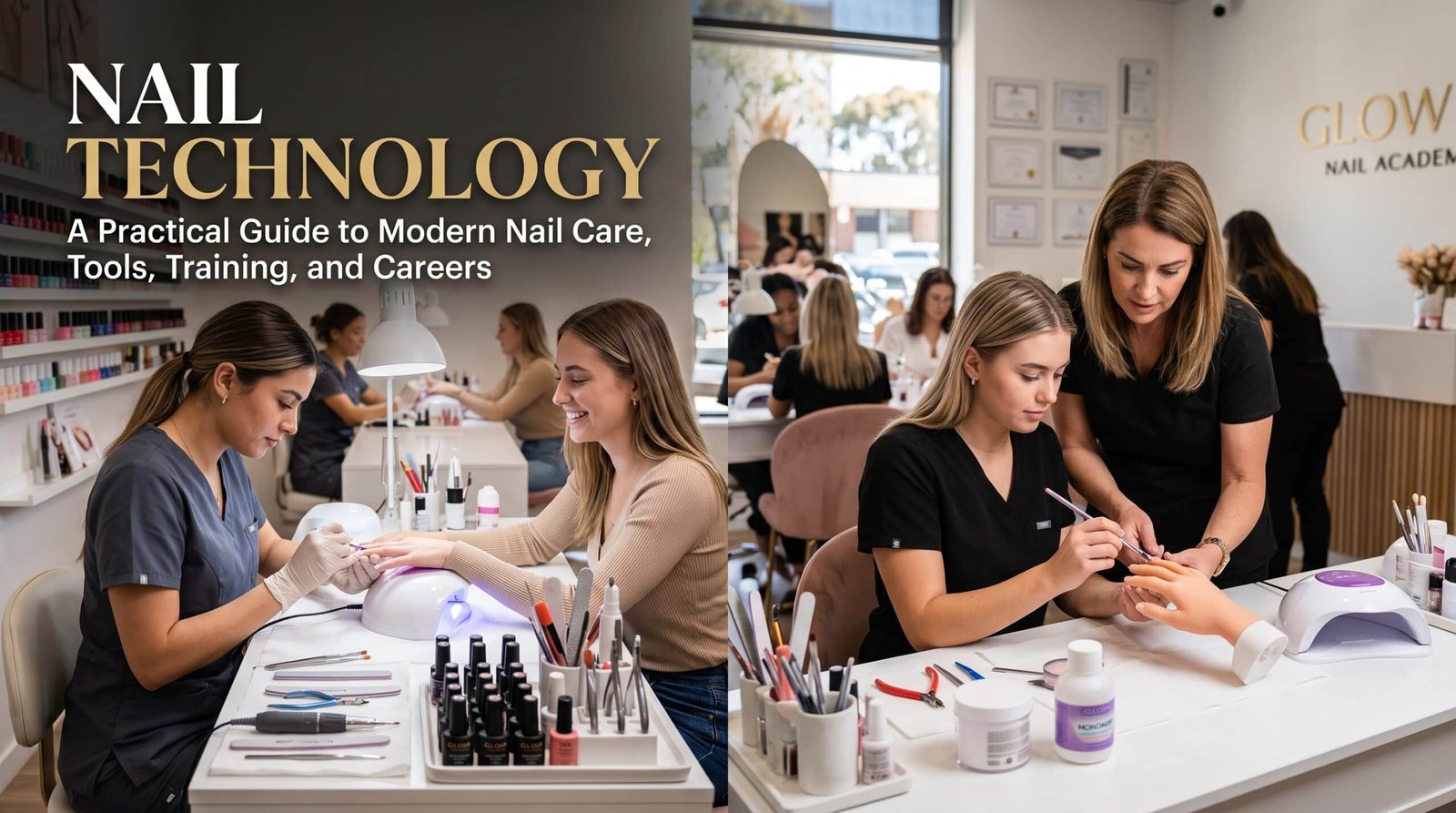
From a basic cosmetic procedure, nails technology has grown into a specialist sector combining product knowledge, technical skills, design, personal care, and modern tools. Two elements of a professional nail treatment are color selection and polish application. Depending on the service, a technician may utilize specialist tools, work with improving materials, create a specific form, get the natural nail ready, and finish the service with complex nail art.
For people interested about the beauty sector, it also has a range of alternatives. While some professionals focus on natural nail maintenance, others excel in extensions, gels systems, nail art, salon administration, or freelancing.
Knowing how the company runs might help would-be nail technicians and consumers both.
What Is Nails Technology?
Professional area related with the maintenance, appearance, improvement, and decorating of fingernails and toenails is nails technology.
A nail technician can offer a lot of different kinds of beauty services, like these:
- Manicures
- Pedicures
- Natural nail care
- Gel polish services
- Acrylic enhancements
- Builder gel services
- Nail extensions
- Nail repairs
- Nail shaping
The precise services a professional can lawfully offer relies on their training and local laws.
The job calls on both accuracy and applied experience. A technician has to know how to get the nail ready, choose appropriate items, run equipment properly, and keep a clean workspace.
Why Nails Technology Call for More Than Just Artistic Ability
Though it is just one component of professional nail work, nail art is among the most obvious elements of the industry.
A technician also has to understand basic nail structure, product behavior, hygiene, client communication, and safe application techniques.
For example, a good design could look fantastic, but bad execution or insufficient planning can affect the way the service degrades over time. Similarly, using an electric file without appropriate training can create unnecessary heat or remove too much natural nail.
This is why professional education matters. Good nail work combines appearance with technique.
Understanding the Natural Nail
Understanding nail anatomy lets experts operate more precisely.
Keratin is the main component of the visible nail plate; it develops from the matrix. Beneath the nail plate is the nail bed; the nearby folds of skin serve to protect the nail structure.
During a manicure, the free edge—the part that reaches beyond the fingertip—may be formed.
Knowing these fundamental forms enables a technician to spot a moment when a cosmetic procedure ought to be postponed or changed. A nail technician ought to also be aware of the boundaries of their job. An appropriate healthcare expert should be consulted for persistent pain, severe swelling, suspected infection, or other medical issues instead of seen as a cosmetic concern.
Common Nails Technology Systems
Modern salons use several different product systems. Each has its own characteristics and application requirements.
Gel Systems
Gel products are widely used for color, overlays, and other nail enhancements. Many gel systems are cured using an LED or UV lamp.
The curing process is an important part of the service. The appropriate lamp, curing time, product thickness, and application method depend on the specific system.
Using products according to the manufacturer’s instructions is therefore important.
Acrylic Enhancements
Acrylic systems commonly use a liquid and powder combination that forms a workable material. A technician can shape this material to create additional length or structure.
Acrylic services can produce a range of shapes and designs, but proper preparation, application, maintenance, and removal are essential.
Builder Gel
Builder gel is generally thicker than ordinary gel polish and is designed to provide additional structure.
It can be used to reinforce a natural nail or create certain enhancement styles. Different builder-gel products have different properties, so technicians should learn the requirements of the particular system they use.
Nail Extensions
Extensions are used when a client wants additional length.
Depending on the technique, a technician may work with tips, forms, gel, acrylic, or other enhancement systems. Shape and length should be selected according to the client’s preferences, lifestyle, and the technician’s assessment of the service.
Tools Used in Professional Nail Services
The tools used depend on the type of service being performed.
Common equipment includes:
- Nail files
- Buffers
- Cuticle tools
- Nail clippers
- Application brushes
- Nail tips
- Sculpting forms
- Electric files
- LED or UV lamps
- Dust-control equipment
- Cleaning and disinfection supplies
Tools should be used for their intended purpose. More advanced equipment does not automatically produce better results. The technician’s training and technique remain important.
Electric Nail Files and Modern Equipment
Electric nail files are an example of how equipment has changed professional nail services.
An e-file can help a trained technician shape enhancement material, refine surfaces, and remove certain products more efficiently than manual filing.
However, an e-file must be handled carefully. Incorrect pressure, speed, angle, or bit selection can cause unnecessary heat or filing.
For someone learning nails technology, mastering manual filing and understanding nail structure should come before relying heavily on advanced equipment.
The Role of Nail Art
Nail art has become an important creative area within the industry.
Simple designs may involve lines, dots, French tips, or color combinations. More advanced work can include hand-painted illustrations, chrome effects, textured finishes, decorative stones, and layered designs.
Digital platforms have also changed how clients discover nail styles. Online, a consumer can locate a design and apply it as inspiration at a salon visit.
This gives technicians chances to create a distinctive look and compile a portfolio of work.
Hygiene and Sanitation
Any professional nail service should follow correct hygiene standards.
Normal salon use can cause contamination of tools and surfaces; hence, cleaning and sanitising techniques are quite important. Reusable tools should be managed consistent with relevant rules; disposable things should be thrown away when needed.
Hand hygiene and workstation cleanliness also count.
Professionally produced equipment and product makers give directions that technicians should abide by together with the sanitation laws applicable to their location.
Good sanitation is not simply a cosmetic detail. It is part of responsible professional practice.
Choosing the Right Nail Service
Different clients have different goals.
Someone who wants a temporary color change may prefer conventional polish. Another client may want the appearance and wear characteristics associated with a gel service. An improvement or extension could be something someone seeking more length might think about.
Not everyone will find a single solution.
A consultation can assist to define the client’s demands, level of maintenance they are willing to perform, and ideal service for their circumstances.
A professional should also clarify realistic expectations instead of promising that one product will address every nail issue.
Nail Care Between Salon Appointments
Professional nail care keeps going even after the appointment.
Avoiding unneeded picking, peeling, or aggressive removal of improvements helps customers to help to keep their nails. Nails shouldn’t be utilized as instruments to scrape surfaces, open boxes, or undertake work requiring extreme strain.
Regular maintenance might also be required as the natural nail develops.
If an enhancement begins lifting, clients should avoid pulling it off themselves. The appropriate removal or repair method depends on the product that was used.
Becoming a Nail Technician
People interested in nails technology as a career generally need practical education before providing professional services.
Training may cover areas such as:
- Manicure and pedicure procedures
- Natural nail care
- Nail enhancement systems
- Product handling
- Nail anatomy
- Sanitation
- Equipment safety
- Nail art
- Client consultation
- Salon practices
Licensing and education requirements are not identical everywhere. While some governments include nail care inside more general cosmetology rules, others control nail technicians by particular licenses.
Anyone considering going into the field ought to verify the requirements of the location they hope to work in.
Career Options in Nails Technology
A nail technician does not necessarily have to follow one career path.
Possible professional settings include:
Nail Salons
A traditional nail salon allows experts to focus mostly on nail treatments and get experience with several clients.
Beauty parlors and spas
Some technicians support beauty experts include masseuses, estheticians, stylists, or others.
Individual Project
Experienced technicians might decide to work alone, rent a space, or create their own clientele.
Mobile Nail Services
Some professionals provide services at a client’s home or another agreed location. This model requires suitable portable equipment and careful scheduling.
Nail Education
Experienced professionals may eventually move into education or training, depending on local qualifications and regulations.
Technology Beyond the Nail Service
The word “technology” in nails technology is not limited to tools used directly on the nails.
Digital systems are changing how many nail businesses operate.
Online appointment systems can make scheduling easier. Digital payment systems can simplify transactions. Software for customer management could assist arrange service histories and appointments.
Since nail services are very visual, social media has also grown in significance as a major marketing tool. Photographs and videos help a professional show techniques, highlight finished work, and talk to possible clients.
Though they can help a tiny nail company run and advertise more easily, these tools do not replace technical expertise.
What Makes a Professional Nail Service Different?
A professional service is not defined only by the finished appearance.
Several factors contribute to quality:
Preparation: The nail should be appropriately prepared for the selected service.
Product knowledge: The technician should understand how the products are intended to be used.
Technique: Filing, application, shaping, and curing should be performed correctly.
Sanitation: Tools and work areas should be maintained according to applicable requirements.
Communication: The technician should understand the client’s expectations before beginning.
Aftercare: Clients should receive appropriate information about maintaining their service.
Together, these factors create a more complete professional experience.
The Future of Nails Technology
The industry is likely to continue changing as manufacturers develop new products and salons adopt new digital tools.
Future developments may include improved formulations, more specialized equipment, digital design tools, and increasingly personalized services.
Artificial intelligence and image-based applications may also help customers explore possible nail designs before an appointment. At the same time, experienced technicians will continue to provide something technology cannot completely replace: hands-on judgment and personalized service.
The most useful developments will be those that improve efficiency or creativity without compromising safety and professional standards.
Commonly Asked Issues
Meaning of nails technology?
Professional treatment, improvement, upkeep, and adornment of fingernails and toenails is known as nails technology. It covers services including manicures, pedicures, gel applications, acrylic improvements, extensions, and nail art.
A beginner should first learn what?
Before moving into more complex enhancement techniques, a novice should build a foundation in natural nail care, nail anatomy, sanitation, product handling, filing, shaping, and basic manicure procedures.
Is nails technology mostly about nail art?
Negative. One aspect of the subject is nail art. Natural nail care, improvements, disinfection, product expertise, equipment usage, client consultation, and expert upkeep are also part of nails technology.
Are nail technicians considered medical professionals?
Most likely not. Nail technicians offer aesthetic treatments. They should understand circumstances outside their purview and suggest that patients get correct medical care when required.
Can nails technology really be a career that takes up all your time?
Affirmative. Local laws and the person’s training will determine whether nail technicians operate in salons, spas, independent companies, mobile services, or education.
Why in nails technology is hygiene so crucial?
Good sanitation keeps a clean professional environment and lowers dangers linked with unclean tools and surfaces. Technicians ought to abide by pertinent product guidelines and local laws.
Conclusion
Nails technology is a combination of professional nail care, cosmetic science, equipment, creativity, and client service. Modern technicians can work with natural nails, gel systems, acrylics, builder gels, extensions, and a growing selection of decorative techniques.
The field also extends beyond the treatment itself. Online portfolios, social media, payment technologies, and digital booking platforms are altering the management and marketing strategies of nail artists.
Knowing these services helps customers to select a proper treatment and express expectations. For those thinking about the field, improving technical abilities, product knowledge, cleanliness procedures, and clear communication gives a realistic basis for joining the industry.
Though items and tools keep changing, the basic tenet is still the same: technology is most helpful when it helps competent, knowledgeable, and responsible professional treatment.