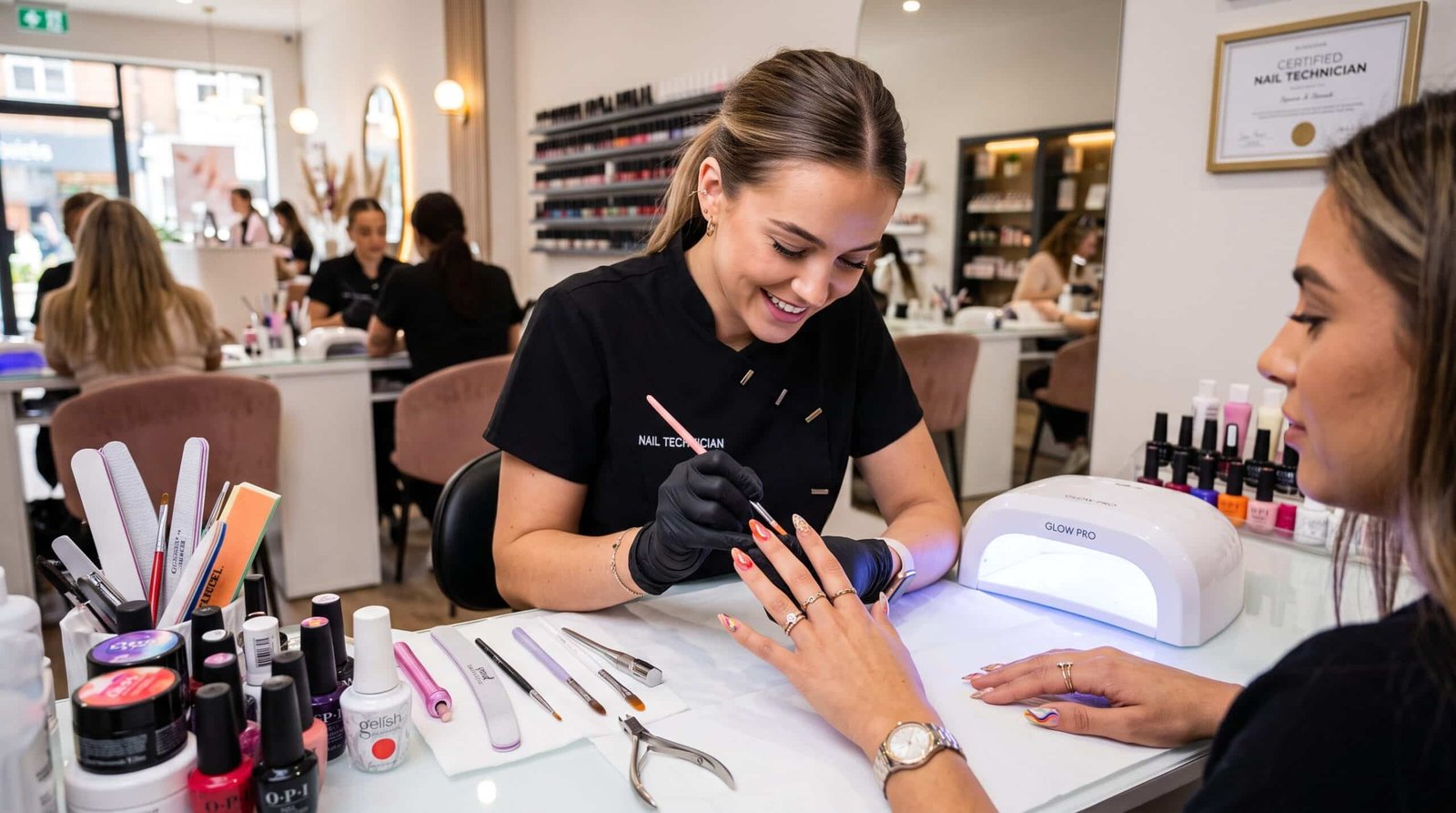
Today’s beauty business heavily relies on nail technology.From a basic grooming service, it has developed into a specialty that makes use of professional instruments, nail enhancement systems, cosmetics, hygienic procedures, and imaginative design.
Today’s nail specialists do sophisticated nail art, gel systems, acrylic improvements, extensions, and natural nails. Simultaneously, changes in product composition and technology are changing the approach of nail treatments.
Understanding the principles will enable you to choose better whether you want to learn modern nail techniques, are interested in professional nail care, or are thinking of a job in nail technology.
What Is Nail Technology?
Nail technology is the professional activity of preserving, enhancing, and decorating fingernails and toenails.
A qualified nail technician can carry out tasks like:
- Manicures
- Pedicures
- Nail shaping and polishing
- Gel polish application
- Acrylic enhancements
- Nail extensions
- Nail art
- Nail enhancement maintenance
Practical skill is combined with knowledge of nail supplies, tools, cleanliness, and customer service in this line of work.
In addition to knowing how to produce a visually appealing outcome, a competent technician must also know how to handle cosmetics and equipment properly.
How Modern Nail Technology Has Developed
Nail services have changed considerably as new products and equipment have entered the beauty market.
Traditional nail polish remains widely used, but clients now have access to systems designed for different purposes. While acrylic and builder-gel solutions can be used to increase length or structure, gel materials can offer a long-lasting glossy finish.
The equipment used in salons has also been impacted by technology. Certain professional procedures are now more accurate and effective thanks to electric nail files, LED curing lights, specialist brushes, and better product formulas.
But professional competence cannot be replaced by technology. Correct preparation, application, hygiene, and aftercare are still critical to the quality of a nail service.
Common Nail Enhancement Systems
Gel Nail Systems
Gel products are widely used for manicures and nail enhancements. Depending on the particular product, a gel is cured under an LED or UV lamp.
Gel services can provide a smooth and glossy finish. Different gel formulations are designed for different applications, so technicians need to follow the manufacturer’s instructions regarding application and curing.
Acrylic Nails
Acrylic enhancements use a liquid and powder system that creates a material capable of being shaped over the natural nail or an extension.
The technician can file and shape the material once it has solidified. Acrylics are popular among clients who desire longer nails since they may be utilized to add more length and structure.
Since excessive filing or improper removal might damage the natural nail, proper preparation and application are crucial.
Builder Gel
A thicker gel substance called builder gel is intended to provide structure. It can be utilized as part of an enhancement service or put over a natural nail.
Because of its uniformity, a technician may construct a suitable shape without sacrificing its smooth appearance. Different builder gels have different properties, so professional training and manufacturer instructions are important.
Essential Tools Used by Nail Technicians
Professional nail services require a range of tools. The exact equipment varies according to the service being performed.
Common tools include:
- Nail files
- Buffers
- Cuticle pushers
- Nail clippers
- Brushes
- Nail tips
- Forms
- Electric files
- LED or UV lamps
- Dust-removal equipment
- Cleaning and disinfection supplies
Each tool has a specific purpose. For example, files help shape the nail, brushes help apply products accurately, and curing lamps are used with products formulated to harden under the appropriate light.
Excessive pressure or the incorrect instrument might result in needless harm.
The Importance of Nail Preparation
Preparation is one of the most important stages of a professional nail service.
Before applying polish or an enhancement, the technician generally needs to clean and prepare the nail surface. The nails may be shaped, and the surrounding area may be prepared according to the service being performed.
Good preparation can improve product application and the appearance of the finished result.
However, preparation should not involve unnecessarily aggressive filing. The natural nail should be treated carefully, particularly when repeated enhancement services are being performed.
Nail Art and Creative Design
Nail technology is not limited to maintenance and enhancement. It has also become an important creative field.
Nail artists can use different techniques to create customized designs, including:
- French tips
- Ombre effects
- Geometric patterns
- Metallic finishes
- Minimalist designs
- Hand-painted artwork
- Decorative stones
- Seasonal designs
- Textured effects
Social media has also influenced nail design trends. Clients can find inspiration online and bring examples to their technician when requesting a particular style.
Hygiene and Sanitation in Nail Services
An essential component of professional nail care is sanitation.
Tools used by nail technicians may come into touch with flesh, nail dust, and cosmetics.Reusable equipment therefore needs appropriate cleaning and disinfection according to applicable professional requirements.
Work surfaces should also be kept clean, and disposable materials should be handled appropriately.
Salons should follow the health and sanitation rules applicable to their location. Product manufacturers’ instructions should also be followed carefully.
Good hygiene protects both the client and the technician and contributes to a professional salon environment.
Nail Technology and Nail Health
The state of the natural nail should always be taken into account while providing cosmetic nail therapies.
A customer should notify their technician if they experience discomfort, strange changes, edema, or other concerning symptoms. A nail technician should provide cosmetic services rather than medical diagnoses.
If a nail or surrounding skin has a persistent or concerning abnormality, consulting an appropriate healthcare professional is more suitable than simply covering it with polish or an enhancement.
The Role of Technology in Modern Nail Salons
Technology has changed more than just the products used on nails.
Modern salons can use digital appointment systems, online portfolios, electronic payment systems, customer-management software, and social media to manage their businesses.
Some nail professionals also use digital tools to showcase designs and communicate with clients before appointments.
From the service itself to salon management, technology has therefore become part of many areas of the modern nail industry.
Choosing the Right Nail Service
The client’s objectives and the state of their natural nails determine the ideal nail treatment.
Someone who wants a temporary color change may prefer conventional polish. A client looking for a longer-lasting finish might consider a gel system. Someone interested in additional length may choose an appropriate extension or enhancement service.
There is no single system that is ideal for everyone.
A qualified specialist may go over the various choices and describe the application, upkeep, and removal of each service.
How to Keep Up Nail Improvements
Maintaining the look and health of nail additions requires aftercare.
Consumers should not use their fingernails to open containers or scrape rough surfaces. Regular maintenance sessions can prevent benefits from becoming difficult or unpleasant to sustain in addition to addressing development.
Clients should refrain from forcefully pulling or peeling away an augmentation. Removal should follow the appropriate procedure for the specific product.
Following professional aftercare instructions can help reduce unnecessary stress on the natural nail.
Nail Technology as a Career
Nail technology can provide a career path within the beauty and personal-care industry.
Training programs may cover:
- Nail anatomy
- Manicure and pedicure techniques
- Nail enhancements
- Product application
- Nail art
- Sanitation
- Client consultation
- Salon safety
Location-specific requirements for professional activity differ significantly. Certain fields call for certain training, tests, licensure, or registration.
Anyone who wants to operate as a professional nail technician should familiarize themselves with local laws.
Competencies Required of a Nail Technician
Technical knowledge is only one part of the profession.
Additionally, a competent nail technician could gain from:
Pay attention to details: The final appearance can be significantly impacted by even little changes in product application and form.
Creativity: The ability to create or replicate intricate designs is frequently necessary for nail art.
Communication: Before starting a service, it is crucial to know what the client wants.
Time management: Technicians must do tasks quickly without sacrificing quality.
Hygiene awareness: In a professional salon setting, clean working procedures are crucial.
FAQs
What is nail technology?
Nail technology is the professional field focused on nail care, maintenance, enhancement, and decoration. It includes services such as manicures, pedicures, gel applications, acrylic enhancements, extensions, and nail art.
What tools do nail technicians use?
Common tools include files, buffers, brushes, cuticle tools, clippers, nail tips, forms, electric files, curing lamps, and sanitation equipment.
Are acrylic and gel nails interchangeable?
No, gel and acrylic are two distinct product systems with distinct compositions and methods of application. While acrylic systems usually harden by a chemical reaction between liquid and powder components, gel goods often need to be cured with the proper LED or UV lamp.
Is a career in nail technology possible?
Nail technicians can, in fact, work in independent businesses, salons, and spas. Nail treatments are a component of the professional beauty sector. The jurisdiction determines the standards for training and licensure.
Why is cleanliness crucial in nail salons?
Sanitation helps to maintain a clean working environment and reduces the risk of contaminated instruments and surfaces. Expert technicians should follow all applicable local laws and product instructions.
Concluding Remarks
Beauty, inventiveness, technical proficiency, product expertise, and professional cleanliness are all combined in nail technology. From basic manicures to gel systems, acrylic improvements, extensions, and intricate nail art, modern nail treatments provide a wide range of alternatives.
Clients may find it simpler to select the best alternative if they are aware of the distinctions between providers. Learning appropriate methods, hygienic practices, product handling, and client communication offers a crucial basis for anyone thinking about a career in this field.
The nail business will continue to advance with contemporary beauty technology as goods, machinery, and digital tools continue to advance.