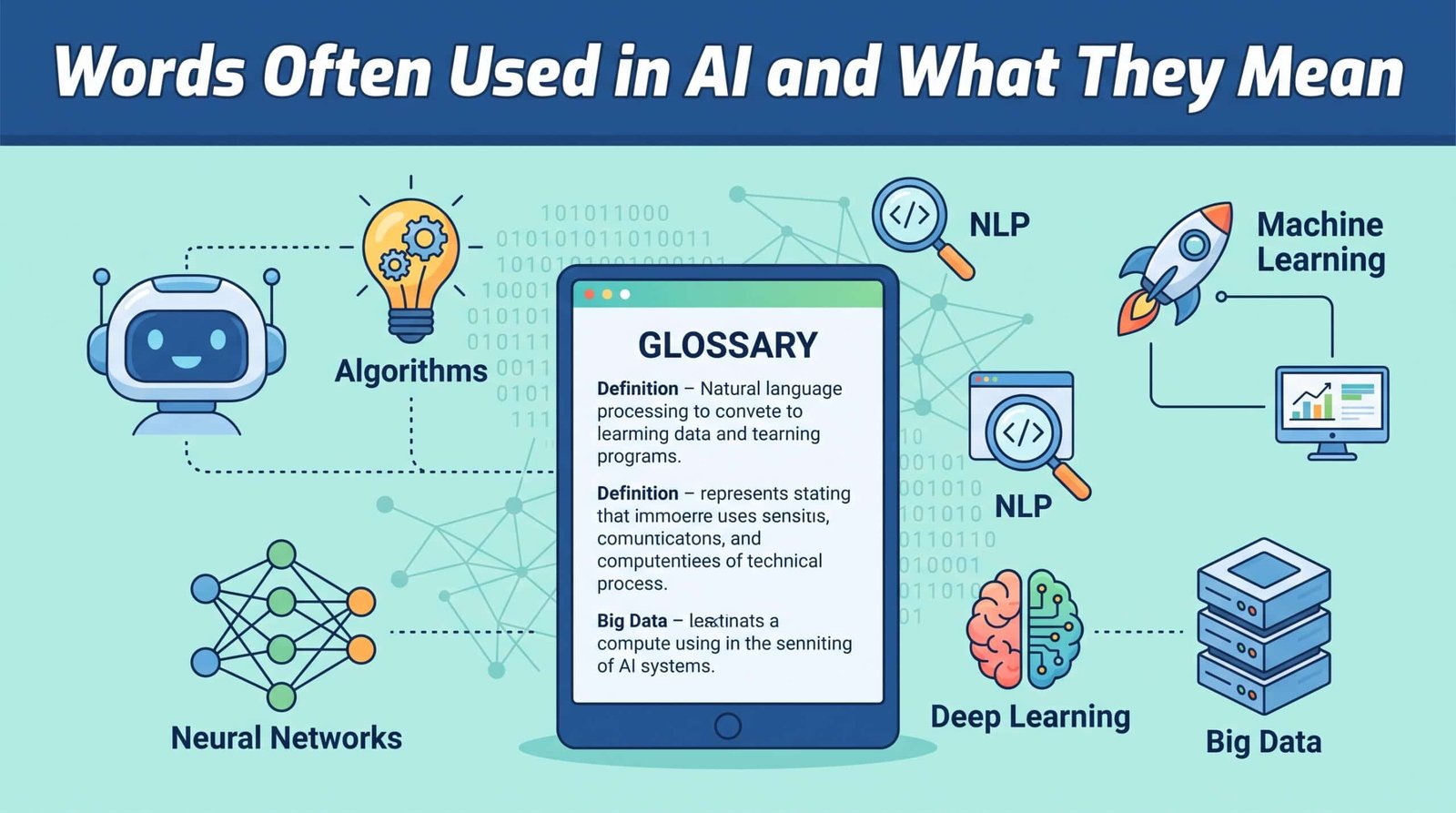
Despite the fact that its language can frequently be unclear, artificial intelligence is a technology that is already widely employed. Ai words People come across terms like “machine learning,” “generative artificial intelligence,” “large language models,” “prompts,” “algorithms,” and “neural networks” without always understanding what they imply.
This manual offers succinct explanations of often used AI concepts. Learning these concepts might greatly simplify the subject, whether you are just starting out in artificial intelligence, searching for AI products, or just trying to grasp technical news.
What Does “AI Words” Mean?
In general, the term “AI words” refers to terms and phrases used in discussions of artificial intelligence.
AI technologies, procedures, applications, systems, and concepts can all be described by these names. While some are technical, others are now frequently discussed in discussions about AI.
For instance, “transformer architecture” is a more technical phrase, although “chatbot” is very simple to understand.
Common Terms in Artificial Intelligence for Novices
Artificial Intelligence
Artificial intelligence (AI) refers to computer programs designed to perform tasks that normally require human intelligence, such as pattern recognition, language processing, problem solving, and prediction.
AI is a broad field rather than a single technology.
Machine Learning
A subfield of artificial intelligence called machine learning (ML) uses data to identify patterns that computer systems can use to forecast or make judgments.
Developers can use examples to teach a machine-learning system rather of manually programming every potential rule.
Generative AI
Generative AI refers to AI systems that can generate new content based on patterns learned during training.
Depending on the system, generated content can include:
- Text
- Images
- Audio
- Video
- Computer code
Generative AI is one of the most visible areas of modern artificial intelligence.
AI Model
A computer system that has been trained to carry out certain tasks or generate predictions is called an AI model.
Different versions are made for different uses. Some process language, while others work with images, audio, structured data, or multiple types of information.
Large Language Model
An AI model created to process and produce language is called a large language model (LLM).
LLMs are capable of answering inquiries, summarizing texts, interpreting languages, coming up with ideas, and producing drafts.
Prompt
An AI system receives instructions or input in the form of a prompt.
An AI assistant may be asked to provide a straightforward explanation of a scientific idea, for instance. The prompt is the instruction.
The utility of an answer can be influenced by the prompt’s quality and clarity.
Chatbot
A chatbot is a piece of software that uses a conversational interface to interact with users.
While current AI chatbots may utilize machine-learning models to create replies dynamically, traditional chatbots frequently depended on predetermined rules.
Algorithm
An algorithm is a predetermined series of actions or processes used to carry out a job or solve a problem.
Algorithms are essential to computer science and are utilized in machine learning and artificial intelligence.
A Neural Network
A neural network is a kind of machine learning model that draws some inspiration from the way information is processed by organic nerve systems.
Neural networks are made up of interconnected computer units that are capable of identifying patterns in data.
Deep Learning
Multiple-layered neural networks are used in deep learning, a kind of machine learning.
It has contributed significantly to developments in fields like generative AI, computer vision, and speech recognition.
Additional AI Terms You Might Come Across
Training
Through a procedure known as training, an AI model picks up patterns from data.
During training, the model responds to examples and a predefined learning objective by changing its internal parameters.
Dataset
A dataset is a collection of data used for AI system testing, training, and evaluation.Text, pictures, audio, video, numbers, and other types of data can all be found in datasets.
Inference
The technique of utilizing a trained AI model to generate a result from fresh input is known as inference.
An AI model is performing inference, for instance, when it gets a question and produces a response.
Vision in Computers
The goal of computer vision, a branch of artificial intelligence, is to give computers the ability to evaluate and comprehend visual data, including images and videos.
picture analysis, object detection, and picture categorization are examples of applications.
Natural Language Interpretation
Enabling computers to communicate with human language is the aim of natural language processing, or NLP.
NLP technologies can be used for translation, text analysis, speech-related applications, search, summarization, and conversational systems.
Reinforcement Learning
An agent learns through interactions with its surroundings and feedback related to its behaviors in a machine-learning technique called reinforcement learning.
Researchers have applied it to robotics, games, optimization, and other fields.
AI Agent
An AI agent uses AI capabilities to perform activities and achieve specific goals.
An agent may use software tools, retrieve information, reason about tasks, and complete several tasks, depending on its design.
Hallucination
When an AI system produces false, unsubstantiated, or fabricated information and presents it as trustworthy, people call it an AI hallucination.
This is one of the reasons why customers should verify important information generated by AI.
Bias
AI bias is the term for systematic tendencies in an AI system that could result in unfair or undesirable consequences.
Training data, model design, human assessment, and AI deployment can introduce bias into systems.
AI Safety
AI safety refers to efforts to reduce harmful or unintended behavior from artificial intelligence systems.
It includes areas such as reliability, security, responsible development, and risk management.
Why Learning AI Words Matters
It can be simpler to assess technology claims if one is familiar with fundamental AI terms.
For instance, one article can claim that a business employs “generative AI,” whilst another might refer to a product as a “AI agent.” Understanding the general meanings of those phrases enables readers to pose more insightful queries on the functionality of the technology.
Additionally, it can improve communication between students, writers, developers, entrepreneurs, and regular tech consumers.
AI Words Are Still Evolving
The lexicon of artificial intelligence is constantly evolving due to its rapid development.
Some technical terms eventually become everyday language. Other terms become associated with specific technologies or products. New terminology can also emerge as researchers and companies develop new approaches.
As a result, definitions can occasionally change based on the situation.
Instead of focusing only on an AI term’s name, consider how people use the term when learning a new concept.
A Basic List of AI Vocabulary
Here’s a brief reference:
| AI Word | Simple Meaning |
| AI | Computer systems performing tasks associated with intelligence |
| Machine learning | Learning patterns from data |
| Generative AI | AI that generates new content |
| AI model | A trained computational system |
| LLM | AI model designed for language |
| Prompt | Instruction given to an AI system |
| Chatbot | Software that communicates conversationally |
| Algorithm | Steps used to solve a problem |
| Neural network | Machine-learning model made of connected computational units |
| Deep learning | Machine learning using multi-layer neural networks |
| Dataset | Collection of data |
| Training | Process of teaching a model from data |
| Inference | Using a trained model to generate an output |
| NLP | Technology for processing human language |
| Computer vision | AI for analyzing visual information |
| AI agent | AI system designed to perform tasks toward an objective |
| Hallucination | Incorrect or unsupported AI-generated information |
| AI bias | Systematic patterns that can produce unfair results |
Frequently Asked Questions
What are AI words?
People use AI words to describe artificial intelligence technologies, procedures, systems, and ideas.
What is the most important AI word to learn first?
For beginners, understanding artificial intelligence, machine learning, generative AI, AI model, and prompt provides a useful foundation.
Are AI words difficult to learn?
Some AI terminology is technical, but readers can understand many concepts through simple examples. Learning the basic vocabulary first makes more advanced topics easier.
Why are there so many terms related to AI?
Artificial intelligence covers numerous technologies and fields of study. As new methods and applications emerge, people develop new terms to describe them.
Conclusion
One easy method to get more at ease with artificial intelligence is to learn basic AI terms.
Terms like generative AI, large language models, prompts, neural networks, datasets, inference, and AI agents describe various aspects of this quickly evolving discipline.
You do not need to be a programr to understand the basics. These terms help you evaluate new tools, read AI news articles, and understand how developers use AI in everyday technologies.