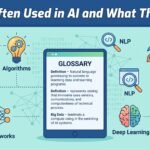
Artificial intelligence has evolved from a niche area of study to a significant component of contemporary technology. AI is being used in a variety of ways by search engines, cellphones, commercial software, creative tools, and many other digital products.The phrase “AI realm” is often used to describe this broad world of artificial intelligence. Machine learning, generative AI, robotics, computer vision, AI assistants, automation, and new research are just a few examples.Understanding the area of artificial intelligence does not require advanced technical understanding.
Understanding the fundamentals of artificial intelligence makes it simpler to comprehend how these technologies operate and their applications.
What Does “AI Realm” Mean?
The term AI realm is not the name of one specific technology. It is a general phrase describing the wider ecosystem of artificial intelligence.
The AI realm includes:
- AI research
- Machine learning
- Generative AI
- Natural language processing
- Computer vision
- Robotics
- AI assistants
- Automation
- AI software
- Data-driven systems
In simple terms, the AI realm is the broad world in which artificial intelligence is developed, studied, and applied.
How Artificial Intelligence Fits Into the AI Realm
Artificial intelligence is a large field containing many different approaches.
Some AI systems analyze information and make predictions. Others generate content or interact with users. Some are designed to control physical machines.
This means there is no single type of AI. Different systems are created for different purposes.
Machine Learning
Instead of relying just on manually created rules, machine-learning algorithms may recognize patterns in data. A model can use these patterns to produce outputs or make predictions based on new data after it has been trained.
Among the uses for machine learning are:
- Recommendation systems
- Fraud detection
- Image recognition
- Speech processing
- Search
- Predictive analytics
Generative AI
Generative AI has become one of the most recognizable parts of the modern AI landscape.
These systems can produce new content based on user instructions or other inputs. Depending on the technology, this can include:
- Text
- Images
- Audio
- Video
- Computer code
AI writing assistants and conversational systems are examples of applications built around generative AI.
Natural Language Interpretation
The goal of natural language processing, or NLP for short, is to make it possible for computers to interact with human language.
Systems can comprehend, analyze, translate, summarize, and produce language with the use of NLP technology.
Applications include:
- Chatbots
- Translation tools
- Search systems
- Text classification
- Speech-related applications
- Document analysis
NLP is particularly important for AI assistants because users often interact with these systems through ordinary language.
Computer Vision
Computer vision is another significant area of artificial intelligence. This technology allows software applications to analyze visual data, such as pictures and movies. A computer vision system can identify objects, categorize pictures, find patterns, or help with visual inspection, depending on the use.
AI and Robotics
Artificial intelligence and real machinery are combined in robotics.
A robot can use software to determine how to react and sensors to gather data about its surroundings. AI can assist robots with object recognition, environment navigation, instruction interpretation, and condition adaptation.
Thus, robotics serves as a crucial link between digital intelligence and physical systems.
Assistants with AI
AI assistants enable natural language communication between humans and computer systems.
Depending on how they are built, AI assistants can aid with things like:
- Responding to queries
- Summarizing information
- Brainstorming
- Writing and editing
- Organizing information
- Explaining concepts
- Supporting software development
AI and Automation
AI can increase the flexibility of automation.
Conventional automation frequently adheres to preset guidelines. For example, AI-based systems can occasionally handle unstructured data, spot trends, and respond to shifting inputs. As a result, AI can increase the flexibility of automation.
Conventional automation often follows predetermined rules.Sometimes unstructured data, trends, and changing inputs can be handled by AI-based systems.
For example, a business might utilize AI to identify incoming documents before processing them automatically. However, human supervision, control, and workflow design are still necessary even with AI.
::
Alternatively, it could be a part of a more extensive automated system.
The Importance of Data
A large portion of the AI field revolves around data.
While AI applications may also rely on databases and outside information sources, machine-learning systems use data to understand patterns.
An AI system’s effectiveness may be impacted by the organization, quality, and relevancy of the data.
The use of artificial intelligence Advantages
AI can provide useful capabilities across many industries.
Faster Information Processing
Depending on the purpose and system architecture, AI systems can process vast volumes of data rapidly.
Assistance With Repetitive Work
AI can help automate certain repetitive digital tasks.
New Creative Tools
Generative AI provides new ways to experiment with writing, images, audio, video, and software development.
Improved Decision Support
AI is able to identify patterns in data that may help with the investigation of difficult problems.
However, human assessment of AI-generated outputs is still necessary, particularly if a mistake has major consequences.
Challenges in the AI Realm
However, artificial intelligence creates important challenges.
Privacy
AI applications may process user information, making privacy practices an important consideration.
Security
AI systems may raise new cybersecurity and abuse issues, necessitating the implementation of suitable security measures.
Transparency
Sometimes it can be difficult to understand why a complex AI system produced a particular result.
These issues are included in the broader discussion regarding the creation of ethical AI.
What Can We Look Forward to in AI?
The AI environment is still developing quickly.
More sophisticated AI assistants, enhanced multimodal systems, more specialized AI applications, robots, automated workflows, and novel methods of human-computer interaction are all possible future advances.
Reliability, privacy, security, safety, and responsible use must all be taken into consideration as technology advances.
Frequently Asked Questions
What is the AI realm?
The AI realm is a general phrase describing the broad ecosystem of artificial intelligence technologies, research, applications, and industries.
What technologies are part of the AI realm?
Machine learning, generative AI, natural language processing, computer vision, robotics, AI assistants, and AI-powered automation are all examples.
Why is the AI realm growing?
Advances in computing, data availability, machine-learning techniques, and software development have expanded the number of practical applications for artificial intelligence.
Conclusion
Artificial intelligence is being used in many aspects of contemporary technology, from robotics, computer vision, natural language processing, and automation to machine learning and generative AI.
The simplest method for newbies to comprehend this rapidly developing topic is to concentrate on its main categories and useful applications. Understanding the basics can help people better understand new AI-related goods, services, and claims as the field develops.