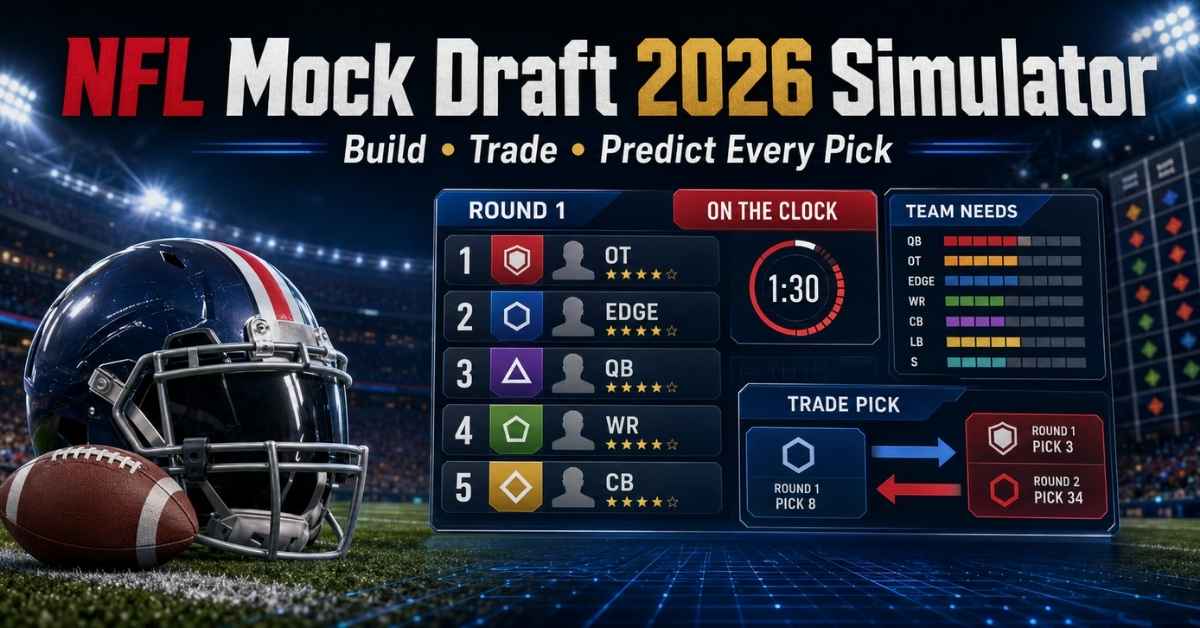
NFL Mock Draft 2026 Simulator tools let you replay the completed 2026 NFL Draft, control one or more teams, make alternative trades, and compare your decisions with the actual 257 selections. Because the 2026 draft has already taken place, you now need a simulator that preserves the previous prospect class—not one that quietly redirects you to a 2027 board.
A historical simulator is more than a prediction game. It allows you to revisit draft-night decisions, undo a controversial pick, trade down for more capital, or test whether your favorite team could have built a better seven-round class.
Is the 2026 NFL Draft Simulator Still Available?
Yes, some platforms still offer a 2026 NFL mock draft simulator, although several major services have moved their default tools to 2027.
Before starting, check three details:
- The simulator still contains the 2026 prospect class
- It uses the final 2026 draft order or offers a historical order
- It clearly distinguishes actual results from simulated selections
MockDrafter advertises an exact-year simulator with more than 300 prospects, all 32 franchises, seven-round drafting, trades, grades, team-needs analysis, and multiple big boards. Bleacher Nation also provides a 2026 tool with the official 257-pick order, adjustable CPU behavior, and custom draft-order controls. MockDrafter, Bleacher Nation simulator
Other well-known platforms, including PFSN and Fanspeak, have moved their main simulators to the 2027 NFL Draft cycle. Always check the displayed year before investing time in a full mock.
Choose the Right Draft Mode
Not every 2026 simulation answers the same question. Decide whether you want a realistic historical replay or a hindsight-driven redraft.
Pre-Draft Replay
This is the most authentic option. It should use only information available before the first selection:
- Draft-week team needs
- Final pre-draft big board
- Known medical information
- Combine and pro-day results
- Original pick ownership
- Actual selections hidden
A pre-draft replay answers: What would I have done with the information available at the time?
Actual Draft Order
This mode uses the final order after real draft-day trades. It is useful when you want to replace individual selections without recreating every transaction.
Alternative Redraft
A redraft allows hindsight. You can use post-draft analysis, final landing spots, and updated opinions to decide what each team should have done.
This can be entertaining, but it should not be confused with a prediction. Once you know the real results, your decision-making environment has changed.
How to Set Up a Seven-Round Mock Draft
A useful NFL Draft simulator should let you control one franchise, several teams, or all 32. You may also allow the CPU to handle every selection and simply watch the board develop.
Select Your Team
Review the franchise’s:
- Number of picks
- First selection
- Total draft capital
- Current starters
- Contract situations
- Injury concerns
- Draft-week needs
- Coaching scheme
A team may have a capable starter and still need a replacement. Contract length, age, salary-cap pressure, and positional depth can turn an apparently secure position into a long-term priority.
Choose the Number of Rounds
A first-round mock is fast, but it offers an incomplete picture. Real roster construction becomes more interesting on Days 2 and 3.
| Draft setting | Best use |
|---|---|
| First round | Testing premium prospects and trades |
| First three rounds | Building around likely contributors |
| All seven rounds | Evaluating depth, development and special teams |
| Custom starting pick | Replaying one specific decision |
A full seven-round NFL mock draft simulator provides the most realistic test because one early trade affects every later selection.
Select a Big Board
A big board ranks prospects by perceived talent. A mock draft predicts where they may be selected. Those concepts are related but not identical.
Useful board options include:
- Editorial rankings
- Consensus big board
- Community average draft position
- Pre-combine board
- Post-combine board
- Final draft-week rankings
- Custom user board
Check the board’s source and date. A ranking created before the college season ended should not silently determine draft grades after the combine.
Need, Value or Scheme Fit?
The hardest decisions happen when the best available prospect does not fill the team’s largest need.
| Situation | Sensible approach |
|---|---|
| Elite prospect falls significantly | Consider best player available |
| Several similar prospects remain | Address the larger need |
| Premium position lacks depth | Consider positional scarcity |
| Team lacks a viable starter | Give immediate need more weight |
| Franchise is rebuilding | Prioritize long-term value |
| Contender has a complete roster | Target a specific role or fit |
Drafting purely for need can lead to a reach. Following the big board without considering the roster can create an unbalanced class.
The strongest strategy usually combines:
- Prospect quality
- Roster need
- Positional value
- Scheme compatibility
- Expected availability later
Watch for Positional Runs
A positional run occurs when several players from the same position are selected in a short span. Quarterbacks, offensive tackles, edge rushers, and cornerbacks can disappear quickly because teams value those roles highly.
Suppose three starting-caliber offensive tackles remain. Your team picks now and again 18 selections later. Passing on the position may seem reasonable, but a run could leave only developmental options by your next turn.
Do not panic simply because other teams have started a run. Ask:
- Is the remaining player still worth this pick?
- How deep is the next positional tier?
- Can I trade down without losing the player?
- Is another premium prospect more valuable?
- What is the probability that my target remains available?
Availability percentages are estimates, not guarantees. They may come from repeated simulations, community drafts, or ranking distributions.
Making Trades in a 2026 NFL Draft Simulator
Trades are often the most entertaining part of a mock, but they are also where realism breaks down.
A quality NFL mock draft simulator with trades should explain why an offer was accepted or rejected.
Trade Up
Trading up may secure:
- A franchise quarterback
- Elite offensive tackle
- Premium pass rusher
- Top cornerback
- Final player in a strong tier
The risk is opportunity cost. Moving up can require several current picks, future selections, or both.
Trade Down
Trading down can produce:
- Additional Day 2 capital
- More chances to find starters
- Future draft picks
- Flexibility across several roster needs
The danger is missing the one elite prospect who justified staying put.
Understanding Trade-Value Charts
Simulators may use different valuation systems:
| Trade chart | General purpose |
|---|---|
| Jimmy Johnson | Traditional pick-value reference |
| Rich Hill | Reflects more modern trade behavior |
| Fitzgerald-Spielberger | Connects draft value with player economics |
| Chase Stuart | Expected-value approach |
| Harvard chart | Analytical pick-value model |
The same offer may appear fair under one chart and uneven under another. Quarterback trades can also exceed standard chart values because several teams may compete for one player.
A transparent trade screen should show:
- Value sent
- Value received
- Percentage difference
- Future-pick discount
- Quarterback premium
- Team motivation
- Reason for acceptance or rejection
How Draft Grades Should Work
An unexplained letter grade has limited value. A simulator should separate the different parts of a decision.
Prospect Value
Did you select the player near his ranking, or did you take him much earlier than expected?
Team Need
Does the prospect address an immediate or future weakness?
Positional Value
Premium positions generally carry more strategic value, especially early in the draft.
Scheme Fit
Does the player’s skill set match the team’s offensive or defensive system?
Trade Value
Did the team gain or surrender reasonable draft capital?
Class Balance
A complete class should ideally contain immediate contributors, developmental prospects, depth, and special-teams value.
A realistic report might look like this:
| Category | Grade |
|---|---|
| Prospect value | A- |
| Team need | B+ |
| Positional value | B |
| Scheme fit | A |
| Trade value | C+ |
| Full class | B+ |
Two simulators may grade the same selection differently because they use different big boards, team needs, trade charts, and positional weights.
Comparing Your Picks With the Actual Draft
The strongest post-draft feature is an actual-results comparison.
The Las Vegas Raiders used the first overall selection on quarterback Fernando Mendoza, who later signed a four-year rookie contract. A historical simulator can let you keep that pick, select another prospect, or trade down. Reuters report on Mendoza’s signing
After completing your mock, compare:
- Exact player matches
- Correct positions
- First-round prospects selected
- Pick-number differences
- Alternative trades
- Draft capital gained or lost
- Team needs addressed
- Overall class balance
Do not decide immediately that your class is “better.” NFL teams possess private medical reports, interviews, background information, and scheme plans that public simulators cannot fully reproduce. Player development also takes years to evaluate.
Four Practical Draft Scenarios
Trading Up for a Quarterback
A quarterback-needy team may need to pay more than a traditional chart recommends. The premium reflects scarcity, competition, and the potential value of securing a long-term starter.
Before trading, calculate what the move leaves behind. A quarterback without adequate protection or receiving support may struggle even if the prospect is talented.
Trading Down From the Top 10
A rebuilding team can turn one early pick into several selections. This approach works best when the board contains multiple players in the same tier.
Trading down becomes risky when one available prospect is clearly superior to the alternatives.
Taking Talent Over Need
Suppose an elite safety falls while your team’s largest need is offensive line. Selecting the better player may create more long-term value, particularly if comparable linemen remain available later.
Waiting Too Long During a Run
If several edge rushers disappear before your next pick, waiting may force you to choose between reaching for a lower-tier player and leaving the need unaddressed. Successful drafts require awareness of prospect tiers, not just overall rankings.
What Makes a Simulator Realistic?
“Realistic AI” is a common marketing phrase, but users deserve a clearer explanation.
A credible CPU model should consider:
- Big-board ranking
- Roster need
- Positional value
- Scheme fit
- Previous selections
- Remaining position depth
- Trade offers
- Expected availability
- Controlled randomness
The simulator should also offer different behavior settings:
- Consensus: Closely follows the chosen board
- Realistic: Allows moderate falls and reaches
- High variance: Creates more surprises and trades
- Custom: Lets the user adjust each factor
Without randomness, every draft feels identical. Too much randomness creates impossible decisions. The best experience sits between those extremes.
NFL Draft Simulator vs. Fantasy Football Simulator
Google sometimes mixes these two tools because both use “mock draft simulator.”
| NFL Draft simulator | Fantasy football simulator |
|---|---|
| Drafts college prospects to NFL teams | Drafts existing NFL players to fantasy rosters |
| Uses NFL pick ownership | Uses fantasy league order |
| Includes franchise trades | Focuses on fantasy lineup construction |
| Evaluates team needs and prospect value | Evaluates scoring, ADP and roster balance |
| Runs through the NFL’s seven rounds | Uses league-specific roster rounds |
FantasyPros and First Down Studio are useful fantasy tools, but they do not recreate the 2026 NFL Draft.
How to Choose the Best 2026 Simulator
Before beginning, use this checklist:
- Does it still offer the 2026 prospect class?
- Is the draft order accurate?
- Are all compensatory picks included?
- Can you draft all seven rounds?
- Can you control multiple teams?
- Does it support future-pick trades?
- Can you choose a big board?
- Are team needs dated and explained?
- Does the simulator show its trade model?
- Are grades transparent?
- Can you save and resume?
- Does it work well on mobile?
- Can you compare with actual results?
- Is basic use free?
- Does it require registration?
Avoid tools with missing prospects, incorrect pick ownership, unnamed boards, impossible trades, hidden payment walls, or no visible update date.
LEARN MORE: World Cup Predictor
How to Get More Realistic Results
Follow this process:
- Choose a final pre-draft 2026 big board.
- Use draft-week team needs.
- Enable moderate CPU variance.
- Select a clearly identified trade chart.
- Hide actual results.
- Avoid using post-draft knowledge.
- Watch positional tiers and scarcity.
- Complete all seven rounds.
- Evaluate the full class, not one pick.
- Run several simulations before drawing conclusions.
One mock represents one possible board. Repeated simulations reveal which players, trades, and roster decisions appear consistently.
Frequently Asked Questions
Can I still use an NFL Mock Draft 2026 Simulator?
Yes. Some platforms preserve the 2026 class for historical simulations, although many major tools have moved to 2027.
Is the 2026 NFL Draft complete?
Yes. The 2026 NFL Draft has concluded, making current 2026 simulations historical replays or redrafts.
How many selections were in the 2026 NFL Draft?
There were 257 picks across seven rounds.
Can I control all 32 teams?
Some simulators allow full control of every franchise. Others limit multi-team drafting or reserve it for premium users.
Can I make trades?
Most advanced tools support pick trades. Future selections, player trades, CPU counteroffers, and multiple valuation charts are less widely available.
How are draft grades calculated?
Grades usually consider prospect ranking, team need, positional value, scheme fit, trade cost, and full-class balance. The exact method differs by platform.
Can I hide the real 2026 selections?
Only some historical tools offer a spoiler-free mode. If this matters, confirm the setting before starting.
Can I use a custom big board?
Several advanced simulators allow custom rankings or offer multiple boards. Check whether importing or editing a board requires an account.
Is an NFL mock draft simulator free?
Most platforms offer basic drafting for free, but custom boards, multi-team control, saving, player trades, or advanced analytics may require registration or payment.
Should I use a 2026 or 2027 simulator?
Use 2026 to replay the completed draft and compare alternative decisions. Use 2027 to project the next NFL Draft class.
Final Takeaway
An NFL Mock Draft 2026 Simulator remains useful after draft night because it transforms the completed event into a strategy exercise. The best tools preserve accurate historical data, support all seven rounds, explain trade decisions, and separate value, need, fit, and capital in their grading.
Start with a spoiler-free pre-draft board if you want a fair challenge. Build the entire class, compare it with the actual selections, and examine what each trade cost. You may not prove that you could replace an NFL general manager—but you will understand the decisions far better.