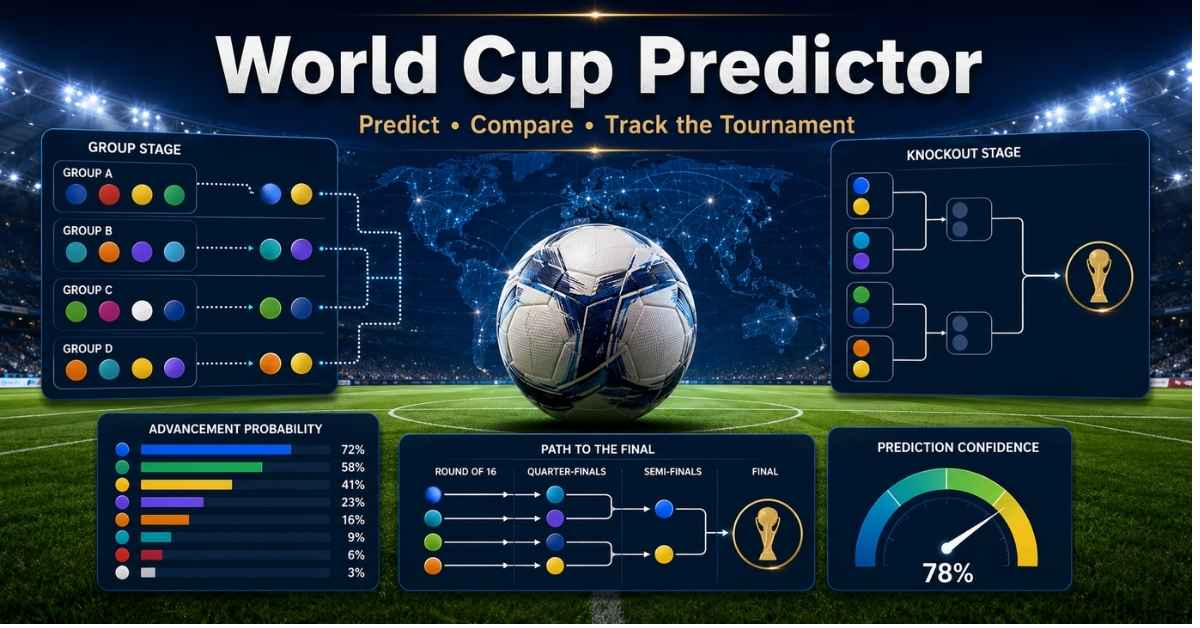
World Cup Predictor tools help you forecast match scores, calculate group standings, build the knockout bracket, and choose the team you believe will become champion. The 2026 FIFA World Cup has ended, but you can still replay the tournament, create alternative results, and compare your bracket with what actually happened.
Spain won the 2026 World Cup after defeating Argentina 1–0 after extra time in the final. The expanded competition featured 48 teams, 12 groups, 104 matches, and a new Round of 32 across Canada, Mexico, and the United States.
What Is a World Cup Predictor?
A World Cup predictor is an interactive tool that lets you forecast part or all of a football tournament. Depending on the platform, you may predict individual scorelines, rank teams in each group, select knockout winners, or simulate the entire competition.
| Tool | What it does |
|---|---|
| Match predictor | Predicts individual scores or winners |
| Group calculator | Converts match scores into standings |
| Bracket predictor | Builds a path from the groups to the final |
| Tournament simulator | Uses a statistical model to generate results |
| Prediction pool | Lets friends compete using a scoring system |
| Historical replay | Creates alternative outcomes for a completed event |
Most searches for “world cup predictor” currently refer to the FIFA football tournament, although similar tools exist for cricket, rugby, basketball, and other sports.
Is the 2026 World Cup Predictor Still Available?
FIFA’s official prediction competitions have closed, but several independent tools still preserve the 2026 group and knockout structure. Some let users view the completed bracket, while others allow alternative match predictions.
Before using a predictor, check whether it offers:
- Historical replay
- All 48 teams
- Correct group tables
- Eight third-place qualifiers
- Official Round of 32 mapping
- Extra time and penalties
- Autosave
- Actual-results comparison
Some pages continue displaying a 2026 title even though their interactive competition has ended. A useful historical predictor should clearly label the tournament as complete rather than pretending predictions are still live.
Choose How You Want to Predict
Quick Bracket Mode
Quick mode is ideal if you want to complete a bracket in a few minutes. You rank the teams in each group, select the eight best third-place teams, and choose every knockout winner.
This method is simple, but it does not explain how the group positions were produced.
Advanced Score Mode
Advanced mode lets you enter every group-stage score. The tool then calculates:
- Matches played
- Wins, draws, and losses
- Goals scored
- Goals conceded
- Goal difference
- Points
- Group position
- Qualification status
This produces a more realistic World Cup group-stage simulator because every score has consequences.
Statistical Simulation
A statistical simulator generates outcomes using team ratings and match probabilities. It may use Elo ratings, FIFA rankings, recent results, expected goals, squad strength, and home advantage.
A transparent model should explain its data. A label such as “AI-powered World Cup predictor” is not enough by itself.
How the 48-Team Format Works
The 2026 tournament expanded from 32 to 48 national teams. Those teams were divided into 12 groups of four.
Each team played three group matches. The scoring system remained familiar:
- Three points for a win
- One point for a draw
- No points for a defeat
The teams advancing to the knockout stage included:
- 12 group winners
- 12 group runners-up
- Eight highest-ranked third-place teams
That produced 32 qualifiers:
12 winners + 12 runners-up + 8 third-place teams = 32
The Round of 32 was followed by the Round of 16, quarterfinals, semifinals, third-place match, and final.
How Group Predictions Become Standings
A good World Cup table calculator updates standings as soon as you enter a score.
Consider a simple four-team group:
| Team | Played | Won | Drawn | Lost | GD | Points |
|---|---|---|---|---|---|---|
| Team A | 3 | 2 | 1 | 0 | +4 | 7 |
| Team B | 3 | 1 | 2 | 0 | +2 | 5 |
| Team C | 3 | 1 | 0 | 2 | –1 | 3 |
| Team D | 3 | 0 | 1 | 2 | –5 | 1 |
Team A wins the group, Team B finishes second, and Team C enters the third-place comparison.
Changing one draw into a defeat could reduce Team C from three points to one. That change might eliminate the team, introduce another third-place qualifier, and alter several knockout matchups.
This chain reaction is what makes a score-based simulator more engaging than manually dragging countries into bracket positions.
FIFA Group Tiebreakers Explained
Teams can finish level on points. The predictor must then apply the official tournament criteria in the correct order.
The process considers factors such as:
- Points
- Goal difference
- Goals scored
- Applicable head-to-head criteria
- Disciplinary record where required
- The final procedure stated in the tournament regulations
The exact rules should be taken from the applicable FIFA competition regulations rather than copied from a different tournament.
A Simple Tie Example
Team A and Team B both finish with four points.
- Team A goal difference: +1
- Team B goal difference: 0
Team A ranks higher because it has the better goal difference.
A quality predictor should include a “Why is this team higher?” explanation beside tied teams. Users should not have to trust a table they cannot understand.
How the Best Third-Place Teams Qualify
The expanded format introduced one of its most confusing elements: ranking the third-place teams from all 12 groups.
A separate table should compare them:
| Rank | Team | Points | Goal difference | Goals scored | Status |
|---|---|---|---|---|---|
| 1 | Team A | 6 | +3 | 5 | Qualified |
| 2 | Team B | 4 | +2 | 4 | Qualified |
| 8 | Team H | 3 | 0 | 4 | Qualified |
| 9 | Team I | 3 | 0 | 3 | Eliminated |
The qualification line falls between eighth and ninth. In this example, Team H advances because it scored more goals than Team I after the earlier criteria remained level.
Later group results can therefore affect teams that have already completed their matches. One goal may change the third-place cutoff and the entire Round of 32.
Building the Round of 32
After the 32 qualifiers are known, the bracket must follow FIFA’s predetermined mapping. Users cannot simply give their favorite country the easiest available opponent.
The World Cup Guide identified 495 possible combinations involving the qualifying third-place teams. A reliable bracket predictor applies the correct mapping automatically and cites the relevant FIFA regulations. World Cup Guide bracket simulator
The complete knockout path includes:
- Round of 32
- Round of 16
- Quarterfinals
- Semifinals
- Third-place match
- Final
A useful path-to-the-final graphic should show every potential opponent a team could face.
Predicting Extra Time and Penalties
A group-stage match can finish level. A knockout match must produce a team that advances.
If the score remains tied after regulation time, the match may proceed to:
- Thirty minutes of extra time
- A penalty shootout if the score remains level
A clear prediction might look like this:
Regulation score: 1–1 Extra-time score: 2–1 Advancing team: Team A
For penalties:
Score after extra time: 1–1 Shootout winner: Team B Shootout score: 4–3
Prediction pools must explain whether points are awarded for the score after 90 minutes, after extra time, or only for selecting the correct advancing team.
How to Choose a World Cup Champion
Do not start with the team name. Start with its likely route.
Examine:
- Group difficulty
- Potential Round of 32 opponent
- Quarterfinal and semifinal pathways
- Squad depth
- Recent form
- Injuries and suspensions
- Tactical flexibility
- Rest between matches
- Travel distance
- Penalty-taking options
A strong team with a difficult route may have a lower championship probability than a slightly weaker side facing a more favorable bracket.
Favorite Does Not Mean Certain Winner
Suppose a model gives these title probabilities:
| Team | Title probability |
|---|---|
| Team A | 20% |
| Team B | 16% |
| Team C | 13% |
| All other teams | 51% |
Team A is the tournament favorite because it has the highest individual probability. It still has an 80% chance of not winning.
This is why confident headlines such as “AI knows the World Cup winner” are misleading.
How Statistical World Cup Predictions Work
Many analytical tools use a form of Monte Carlo simulation.
The process normally follows these steps:
- Assign strength ratings to every team.
- Estimate win, draw, and loss probabilities.
- Simulate every group match.
- Calculate standings and tiebreakers.
- Generate the Round of 32.
- Simulate knockout matches.
- Model extra time and penalties.
- Repeat the tournament thousands of times.
- Count how often each country reaches every round.
A trustworthy model should disclose:
- Rating source
- Rating date
- Number of simulations
- Expected-goals assumptions
- Draw model
- Home-field adjustment
- Injury treatment
- Extra-time method
- Penalty method
- Update schedule
- Historical calibration
One independent simulator reported running 1,000 simulations using June 2026 Elo updates. That information is useful, but readers still need to know which Elo system and match assumptions were used.
Factors That Improve a Prediction
Squad Quality and Depth
A tournament winner needs more than a strong starting eleven. Suspensions, injuries, fatigue, and tactical changes make bench quality important.
Recent Form
Competitive results can reveal improvement or decline. However, one friendly or high-scoring match should not completely reshape a prediction.
Tactical Matchups
A possession-heavy favorite may struggle against a disciplined counterattacking team. Set pieces, pressing, defensive structure, and midfield control can matter more than reputation.
Host Advantage
The 2026 World Cup was held across Canada, Mexico, and the United States. Support, familiarity, travel, climate, and venue conditions could affect teams differently.
Penalty Strength
Goalkeeper performance and experienced takers matter, but shootouts still contain substantial uncertainty. Historical penalty records should not be treated as guarantees.
Common World Cup Prediction Mistakes
Fans often weaken their brackets by:
- Selecting only famous countries
- Predicting every favorite to win
- Ignoring draws
- Treating FIFA rankings as win probabilities
- Overreacting to one recent result
- Forgetting squad depth
- Ignoring third-place qualification
- Using outdated injury information
- Manually creating invalid knockout matchups
- Confusing betting odds with objective probabilities
- Assuming the strongest team has an easy route
- Changing picks emotionally after one upset
A good bracket contains reasoned surprises. An upset-heavy bracket where every outsider advances is no more realistic than choosing every favorite.
Comparing Your Bracket With Actual Results
A historical World Cup predictor becomes more valuable when it explains where your forecast succeeded or failed.
Your accuracy dashboard should include:
- Correct match outcomes
- Exact scorelines
- Correct group winners
- Correct runners-up
- Correct third-place qualifiers
- Correct Round of 16 teams
- Correct quarterfinalists
- Correct semifinalists
- Correct finalists
- Correct champion
- Total points
- Accuracy percentage
It should also identify:
- The first result that changed your bracket
- Your most damaging incorrect pick
- Your strongest dark-horse prediction
- Your best exact score
- The stage where your accuracy declined most
Model evaluation should go beyond whether it named Spain as champion. A probabilistic model can be well calibrated even when its highest-rated team loses.
Creating a Prediction League With Friends
A private World Cup prediction pool adds competition and emotional investment.
Before the first match, agree on:
- Entry deadline
- Prediction-lock time
- Exact-score points
- Correct-outcome points
- Qualification points
- Champion bonus
- Extra-time treatment
- Penalty-shootout treatment
- Tie-breaking method
- Whether picks remain hidden
A simple scoring structure might be:
| Prediction | Points |
|---|---|
| Correct outcome | 2 |
| Exact score | 5 |
| Correct group qualifier | 3 |
| Correct quarterfinalist | 5 |
| Correct semifinalist | 8 |
| Correct finalist | 12 |
| Correct champion | 20 |
Scoring rules should lock before the competition begins. League administrators should not be able to edit predictions after kickoff without leaving a visible record.
Choosing the Best World Cup Predictor
Use this checklist before entering 104 match predictions:
- Correct tournament and year
- Accurate fixtures
- Automatic standings
- Official tiebreakers
- Third-place calculator
- Correct Round of 32 mapping
- Extra-time support
- Penalty support
- Autosave
- Mobile-friendly bracket
- Private leagues
- Shareable results
- Clear privacy policy
- Transparent model
- Historical replay
- Actual-results comparison
Avoid pages with untranslated interface keys, missing update dates, incorrect teams, no autosave, unexplained “AI,” disguised betting promotions, or false FIFA-affiliation claims.
LEARN MORE: Game Update Befitnatic
World Cup Predictor vs. Betting Odds
A predictor and a betting market are not the same thing.
- A model estimates probabilities from data.
- A user bracket records personal beliefs.
- Community percentages show popular selections.
- Betting odds reflect market prices and normally contain a bookmaker margin.
A 25% model probability does not automatically mean a bet offers value. Gambling content should remain clearly separated from an entertainment predictor and include appropriate responsible-gambling information.
Frequently Asked Questions
Who won the 2026 FIFA World Cup?
Spain defeated Argentina 1–0 after extra time in the final.
How many teams played in the 2026 World Cup?
The tournament featured 48 teams divided into 12 groups.
How did teams reach the Round of 32?
The top two teams from each group qualified alongside the eight highest-ranked third-place teams.
Can I replay the completed tournament?
Yes, if the predictor preserves historical groups, fixtures, and bracket logic. Official prediction competitions may be closed, but independent replay tools can remain available.
Can I predict exact scores?
Score-based tools allow exact predictions. Quick bracket tools may ask only for group positions or match winners.
Can a World Cup predictor calculate penalties?
Advanced tools should let users choose the advancing team after a tied extra-time score and optionally enter the shootout result.
Are FIFA rankings the same as title probabilities?
No. FIFA rankings order national teams using a rating system, while title probabilities model the likelihood of surviving a specific tournament path.
Is a World Cup predictor free?
Many predictors are free. Private leagues, permanent storage, advanced statistics, or premium competitions may require an account or payment.
When will the 2030 World Cup predictor open?
That depends on the provider. Detailed predictions become more meaningful after qualification, the group draw, and confirmed squad information.
Final Prediction Checklist
Before building your bracket:
- Confirm the tournament and year.
- Check the groups and fixtures.
- Review squads, injuries, and suspensions.
- Choose quick or advanced mode.
- Read the scoring rules.
- Enable autosave.
- Consider draws and third-place qualification.
- Review each team’s route to the final.
- Save or export the completed bracket.
- Return after the tournament to study your mistakes.
Final Takeaway
A useful World Cup Predictor should do more than display an empty bracket. It should calculate group tables, explain tiebreakers, rank third-place teams correctly, generate the official knockout path, and separate personal picks from statistical probabilities.
The completed 2026 World Cup remains valuable as a historical replay. Build an alternative bracket, compare it with Spain’s actual title run, and identify the single result that changed your entire prediction.