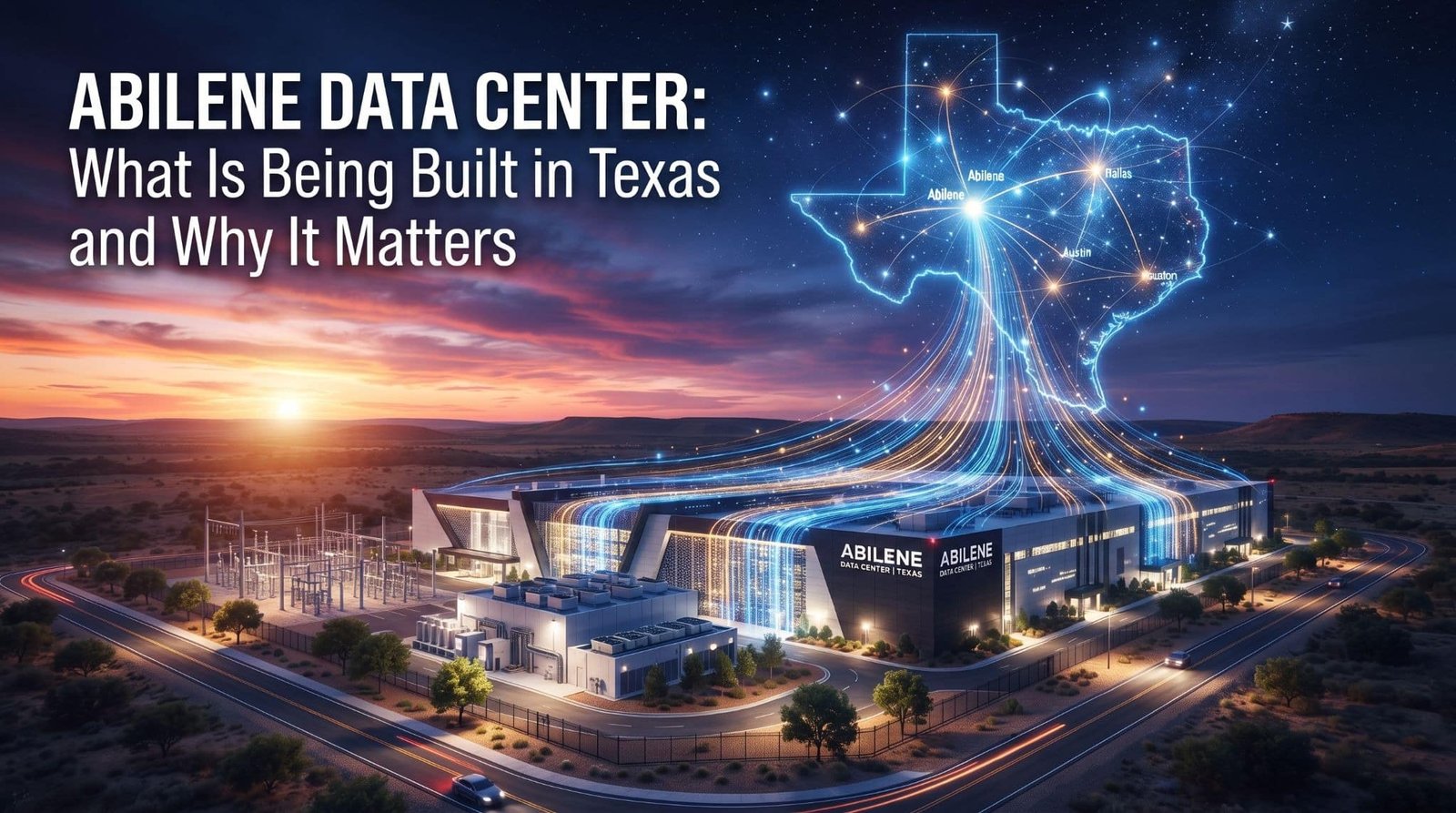
Abilene Data Center: Jobs, Infrastructure & Overall Local Impact
The growth of the Abilene data center industry is changing the way people think about technology investment in West Texas.
Although a data center may appear to be a technology project from the outside, its construction and operation necessitate a far bigger network of individuals and companies.
The ecosystem can include local service providers, construction firms, electricians, engineers, equipment suppliers, network specialists, security teams, maintenance contractors, and transportation organizations.
For Abilene, this creates an opportunity to develop a broader technology economy around artificial intelligence and digital infrastructure.
Why Data Centers Are Important to Abilene
Data centers are physical infrastructure for the digital economy.
Every time someone streams a video, uses cloud software, stores files online, runs an AI model, or accesses a business application hosted remotely, computing infrastructure somewhere has to process that activity.
AI is increasing the scale of that infrastructure.
Training and running advanced AI systems can require large quantities of specialized computing equipment.
That equipment needs:
- Electricity
- Cooling
- Networking
- Physical security
- Monitoring
- Maintenance
- Backup systems
- Specialized buildings
This explains why AI companies and infrastructure providers are investing in very large data center campuses.
Abilene’s Growing Technology Ecosystem
The Development Corporation of Abilene describes the city’s expanding data center and technology network as including information technology, cybersecurity, energy infrastructure, construction, advanced manufacturing, telecommunications, aerospace and defense, and engineering services.
This is significant because a technology ecosystem can be much larger than the companies that own the servers.
Over the course of a facility’s existence, a data center operator may require hundreds of vendors and contractors.
What Kinds of Employees Are Needed for Abilene Data Center Jobs?
The idea that data centers primarily employ software developers is one common myth.
The workforce is actually diversified.
Electrical workers
Complex electrical systems are needed for data centers.
Power distribution, equipment installation, maintenance, and testing are all tasks that electricians and electrical technicians can perform.
Mechanical workers
Cooling systems are essential.
Mechanical technicians can work with HVAC systems, pumps, cooling equipment, and other critical infrastructure.
Network technicians
Servers need high-speed connections.
Network specialists install, monitor, and maintain communication equipment and fiber connections.
Facilities technicians
Facilities personnel help maintain the physical environment that allows computing equipment to operate reliably.
Security professionals
Data centers contain expensive computing hardware and sensitive infrastructure.
Physical security is therefore an important part of operations.
Construction workers
Large teams must build the buildings and accompanying infrastructure before a data center can function.
This covers crafts like plumbing, electrical work, steel, concrete, mechanical systems, equipment operation, and safety management.
Training for Data Center Careers
A growing data center industry creates demand for specialized training.
The Development Corporation of Abilene identifies a data center operator training program through Texas State Technical College that focuses on mechanical, electrical, and information systems.
This type of education is important because modern data centers combine several technical disciplines.
Someone working inside a data center may need to understand both physical infrastructure and computer systems.
That makes data center work different from many conventional IT positions.
Do Data Centers Create Local Business Opportunities?
Yes, but the opportunities extend beyond technology companies.
Consider what happens during the construction of a major facility.
Workers need transportation.
Construction sites need equipment.
Contractors need materials.
Employees need food and accommodation.
Businesses may need staffing services.
Facilities eventually need maintenance and security.
This creates a chain of economic activity.
Local companies that can meet these requirements may benefit from the expansion of the data center sector.
Power Is Central to the Abilene Data Center Story
Power is one of the most important factors in modern AI infrastructure.
A data center cannot operate without reliable electricity.
The Abilene region has access to substantial renewable generation, particularly wind power.
Oracle says its Abilene campus connects directly to the ERCOT grid and can draw from renewable energy in the region.
The project also includes backup generation intended to support reliability.
This illustrates an important point about modern data center development:
Computing infrastructure and energy infrastructure are increasingly connected.
The growth of AI therefore affects not only technology companies but also utilities, grid planning, power generation, transmission, and energy policy.
Why Cooling Matters
Computers turn electricity into useful computing power, but they also produce heat.
As computing density increases, managing that heat becomes more complicated.
AI facilities can contain very high concentrations of computing hardware, making cooling an essential part of their design.
According to Oracle, a closed-loop, non-evaporative liquid cooling technology is used at the Abilene AI complex.
Because liquid cooling may transfer heat more effectively than traditional air cooling in some setups, it is becoming more and more crucial for high-density computing.
Cooling designs, however, vary from institution to facility.
Readers should therefore avoid assuming that all data centers have identical water or energy requirements.
Water Questions
Data center development can raise questions about local water resources.
Those questions should be evaluated project by project.
Factors can include:
- Cooling technology
- Climate
- Facility size
- Operating conditions
- Water source
- Evaporation
- Maintenance requirements
Oracle states that its Abilene campus uses a one-time-fill, closed-loop cooling approach and estimates relatively low annual water use for cooling maintenance.
That is a project-specific claim rather than a universal description of all data centers.
This distinction is important when discussing the environmental effects of the industry.
New Construction Is Expanding the Market
The Abilene data center market is not represented by a single construction project.
Texas Department of Licensing and Regulation records show multiple Vantage data center projects registered in the Abilene area during 2025 and 2026.
For example, one 2026 filing for Vantage DC Abilene – TX3 – Project Frontier identifies a new building of approximately 344,796 square feet.
Another filing identifies a separate building of approximately 398,117 square feet.
These projects have different schedules and estimated costs.
Public regulatory records therefore provide a useful way to distinguish confirmed construction filings from general technology-industry speculation.
What Does This Mean for Local Workers?
For residents, the most important question may not be how many servers are installed.
It may be:
What opportunities are available to people living in the region?
Potential career paths can include:
Entry-level technical roles
People without years of specialized experience may find opportunities in trainee or support roles, depending on employer requirements.
Skilled trades
Electrical, mechanical, construction, HVAC, and equipment skills can transfer into data center work.
Experienced IT professionals
Network engineers, systems specialists, cybersecurity professionals, and technology managers may find roles supporting data center operations.
Professional services
Large infrastructure projects also require project managers, accountants, lawyers, consultants, procurement professionals, and other specialists.
The Housing and Services Effect
Large construction projects can affect more than employment.
If thousands of workers temporarily or permanently enter an area, demand can increase for:
- Housing
- Hotels
- Restaurants
- Transportation
- Childcare
- Healthcare
- Retail
- Professional services
This can create opportunities for local businesses.
At the same time, rapid growth can put pressure on local infrastructure.
That is why economic development should be measured in both benefits and costs.
Infrastructure Beyond the Data Center
A data center does not operate in isolation.
It depends on infrastructure outside its property.
That can include:
- Roads
- Electrical transmission
- Fiber networks
- Water systems
- Emergency services
- Construction suppliers
- Workforce training
- Housing
The Development Corporation of Abilene specifically highlights power, fiber, available development capacity, and workforce development as parts of the city’s growing technology infrastructure.
What Businesses Should Watch
Businesses considering opportunities around the Abilene data center market should think beyond simply trying to become a technology vendor.
Potential opportunities may exist in:
Construction:
Electrical, mechanical, concrete, steel, equipment and project services.
Operations:
Maintenance, HVAC, facilities and security.
Technology:
Networking, cybersecurity, IT support and monitoring.
Logistics:
Transportation, warehousing and equipment delivery.
Professional services:
Accounting, legal, engineering, staffing and consulting.
Community services:
Housing, food, healthcare and transportation.
The strongest opportunities will depend on individual project requirements and procurement processes.
What Could Limit Growth?
Large data center development also faces practical constraints.
Power availability
The grid must accommodate large new loads without compromising reliability.
Water management
Cooling systems must be designed around local conditions and available resources.
Skilled labor
Large projects require workers with specialized construction and technical skills.
Infrastructure
Roads, fiber, electrical systems, and other infrastructure need to expand alongside development.
Community planning
Large-scale projects must take into account how they will impact long-term economic development, transportation, services, and land usage.
Planning becomes more crucial as a result of these problems, although development is not always halted.
Why There Is More to the Abilene Data Center Story Than Just One Building
The most crucial step in comprehending the Abilene data center business is to cease viewing a data center as a single structure.
It is an ecology.
A sizable AI facility links:
Computing → Power → Cooling → Fiber → Building → Employees → Suppliers → Local Companies → Community Infrastructure
The entire project becomes more challenging to construct and run if one link in that chain is absent.
Because of this, investments in data centers can have an impact on sectors that go well beyond traditional technology.
Frequently Asked Questions
What jobs are available at an Abilene data center?
Potential roles include electrical and mechanical technicians, facilities workers, network specialists, security staff, engineers, construction workers, equipment operators, and technology professionals.
Does working at a data center require a computer science degree?
Not necessarily. Some positions require advanced technical qualifications, while others depend on skilled trades, facilities, electrical, mechanical, security, construction, or operational experience.
Why are companies building data centers in Abilene?
Factors include available land, power infrastructure, renewable energy resources, connectivity, workforce development, and the region’s ability to support large-scale infrastructure.
How much electricity does an Abilene data center use?
The answer varies by facility and computing load. Large AI campuses can require substantially more power than conventional enterprise data centers, so individual project specifications should be checked rather than applying one number to every facility.
Will data centers benefit local businesses?
They can create demand for construction, maintenance, transportation, housing, food services, staffing, professional services, and other businesses. The actual benefit depends on project procurement, local participation, workforce availability, and broader economic conditions.
Conclusion
The Abilene data center market represents a broader shift in how artificial intelligence infrastructure is being built in the United States.
The story includes powerful computers, but the computers are only one part of it.
Electricians, engineers, construction workers, network specialists, equipment suppliers, security teams, instructors, local companies, and infrastructure providers all have a role to play.
The region’s ability to integrate this new infrastructure with workforce development, local businesses, dependable energy, connectivity, and appropriate community planning will determine the long-term relevance of data center investment for Abilene.
Because of this, it is worthwhile to follow the Abilene data center business as a narrative about jobs, infrastructure, and the evolving West Texas economy in addition to its technological aspects.