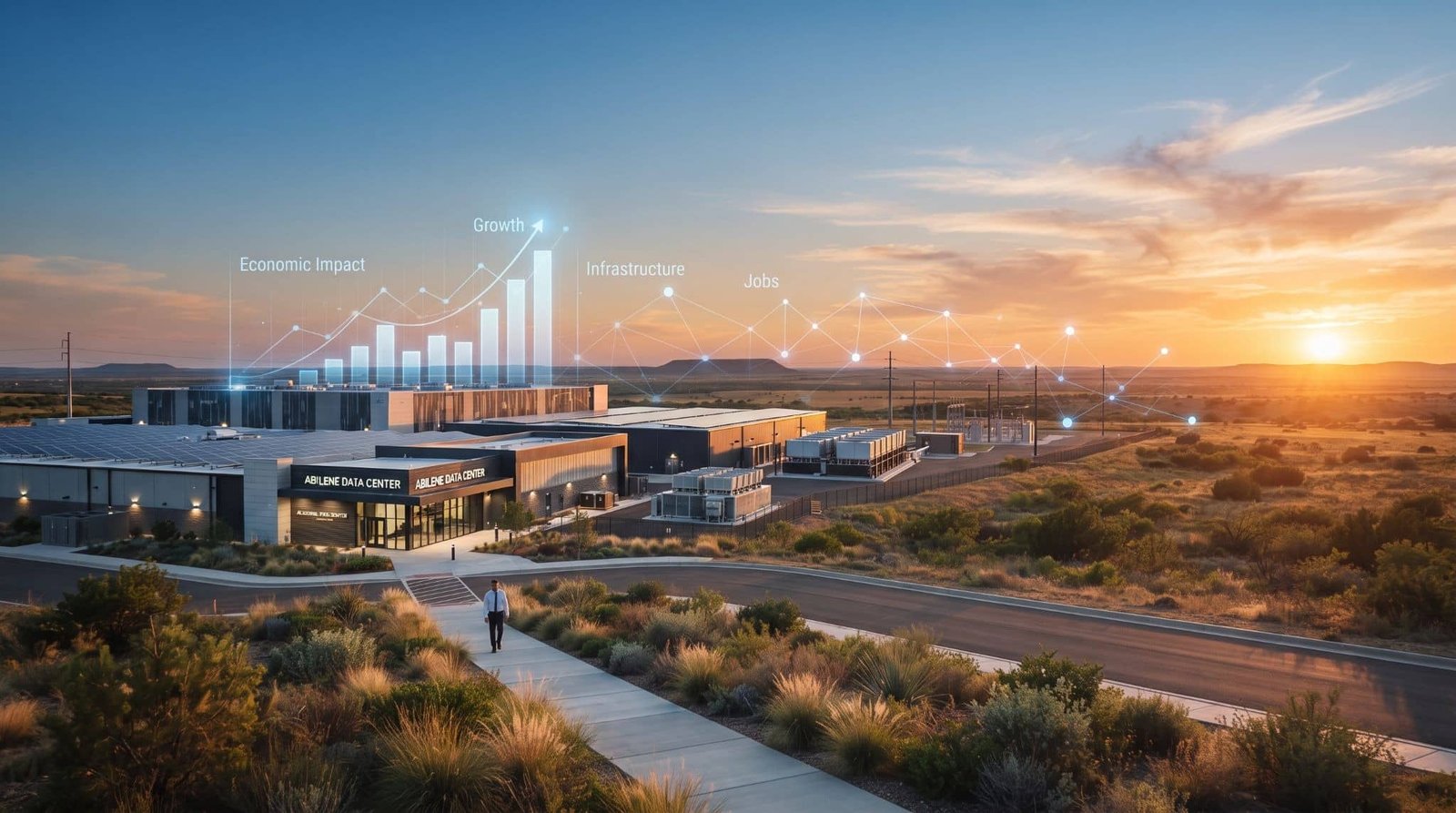
One of the biggest advancements in West Texas’s digital infrastructure is increasingly linked to the term Abilene data center.
Large-scale investments in computing infrastructure intended to serve cloud computing, artificial intelligence, and other data-intensive applications are being drawn to Abilene, Texas. The development involves more than just computer servers. It also requires electricity, fiber connectivity, cooling systems, construction workers, engineers, technicians, security officers, and a wide network of suppliers.
An Abilene Data Center: What Is It?
A data center is a specialized building used to store computer equipment and the infrastructure needed to maintain that equipment.
Servers, networking equipment, storage systems, power distribution equipment, cooling systems, fire protection, monitoring systems, and physical security are all found inside a contemporary building.
For many years, websites, cloud apps, corporate software, databases, and internet services have been powered by traditional data centers.
Artificial intelligence is rapidly being used into the design of the newest generation of facilities.
Numerous high-performance processors running constantly may be needed for AI workloads. As a result, modern AI data centers may consume significantly more electricity and require more infrastructure than typical business server rooms.
This is one of the reasons the market for abilene has drawn interest.
The Large AI Campus Near Abilene
One of the most prominent developments is associated with the Lancium Clean Campus in the Abilene area.
Oracle describes its Abilene AI data center campus as covering approximately 1,100 acres, with eight buildings and about 4 million square feet of building space.
It needs:
- Electrical infrastructure
- Backup power
- High-capacity networking
- Cooling systems
- Construction services
- Equipment maintenance
- Security
- Skilled technical workers
- Transportation and logistics
- Local suppliers
This helps explain why data center development can affect a wider region.
Why Abilene?
The location of a data center is not chosen randomly.
Operators typically evaluate several factors before committing to a large project.
Electricity
Large AI facilities require substantial amounts of electricity.
Abilene’s location in West Texas gives the area access to a power system with significant renewable generation, particularly wind resources.
Oracle says its Abilene facility connects directly to the ERCOT grid and can draw from renewable energy available in the region.
For a data center, the availability and reliability of electricity can be just as important as the availability of land.
Land
Large AI campuses need substantial physical space.
For example, developers may need hundreds or thousands of acres for a large data center campus. The Abilene development includes multiple buildings, electrical equipment, roads, security zones, and other infrastructure.
Connectivity
Servers are useful only when they can communicate with other systems.
Thus, high-capacity fiber and network connections are essential to data centers.
Network providers and telecom firms may be motivated to extend infrastructure throughout the area by an expanding technology ecosystem.
Workforce
Data centers need more than software engineers.
Their workforce can include:
- Electrical technicians
- Mechanical technicians
- Network technicians
- HVAC specialists
- Security personnel
- Facilities engineers
- Construction workers
- Equipment operators
- Project managers
- IT specialists
How AI Changes the Data Center
The rise of artificial intelligence is changing the design of computing facilities.
An ordinary cloud application may use relatively modest computing resources compared with a large AI training system.
AI systems can use specialized accelerators such as GPUs to process enormous amounts of data.
Those processors generate heat, which means cooling becomes a major engineering challenge.
The result is a data center where the power and cooling infrastructure can be almost as important as the computing hardware itself.
Cooling Is a Major Issue
Cooling is essential because servers cannot operate safely if temperatures become too high.
Traditional facilities often use air-based cooling systems.
Oracle says its Abilene campus uses a closed-loop, non-evaporative liquid cooling system and describes the system as designed to reduce water consumption.
There is not just one universal cooling design for a data center. A facility’s technology, climate, cooling design, and operational procedures all affect how much water it uses.
Infrastructure for Power and Backup
A data center cannot rely solely on the public grid without taking reliability into account.
Oracle claims that its Abilene site employs selective catalytic reduction technology as a component of the emissions-control system and uses natural gas turbines for backup power.
This demonstrates the intricate connection between energy infrastructure and data centers.
Large volumes of electricity are required by the sector, and operators must account for disruptions and dependability.
How Does the Abilene Data Center Affect Employment?
Before a facility is operational, large building projects may provide jobs.
Construction can require:
- Electricians
- Welders
- Heavy-equipment operators
- Pipefitters
- Construction managers
- Safety specialists
- Concrete workers
- Equipment suppliers
After construction, operational positions can include:
- Data center technicians
- Facilities technicians
- Network specialists
- Mechanical engineers
- Electrical engineers
- Security staff
- Operations managers
That means the economic effect can extend beyond the people directly employed inside a data center.
Local Businesses Can Be Part of the Ecosystem
A large technology facility creates demand for many services that are not traditionally considered “technology.”
Businesses may provide:
- Construction materials
- Equipment maintenance
- Transportation
- Security
- Food services
- Housing
- Staffing
- Professional services
- Electrical contracting
- Mechanical services
This creates a larger economic network around the physical data center.
The Development Corporation of Abilene describes this ecosystem as extending across construction, energy, network services, cybersecurity, advanced manufacturing, and professional services.
Abilene Data Center Projects Are Not Limited to One Campus
It is important not to treat every data center project in Abilene as the same development.
Public Texas regulatory filings show additional data center construction projects in the Abilene area.
The Texas Department of Licensing and Regulation filed information about Vantage DC Abilene – TX3 – Project Frontier in 2026. The filing describes the project as a new data center building.
The project covers approximately 344,796 square feet and has an estimated construction cost of $945 million.
Other filings identify additional Vantage buildings with different construction schedules and estimated costs.
Why Data Centers Matter to the Future of Abilene
A large data center can influence a city in several ways.
First, it can increase demand for skilled workers.
Second, it can encourage investment in power and telecommunications infrastructure.
Third, it can attract suppliers and service businesses.
Fourth, it can increase demand for training programs that prepare people for technical careers.
Local education and workforce organizations work with the Development Corporation of Abilene on programs that prepare people for data center operations.
Challenges to Consider
Data center development also creates legitimate infrastructure questions.
The most important include:
Water
Cooling requirements vary substantially between data centers.
Communities need accurate information about how individual projects will use and manage water.
Construction impact
During construction, local communities may experience heavier traffic, more noise, greater demand for temporary housing, and increased pressure on local services.
Long-term economic effects
A large capital investment does not automatically mean every economic benefit will be permanent.
Employment, local procurement, infrastructure investment, tax arrangements, and the capacity of local companies and employees to engage in the expanding sector all influence the long-term effects.
What Distinguishes the Abilene Project from a Conventional Data Center?
The biggest difference is the relationship with artificial intelligence.
AI computing requires enormous amounts of processing capacity.
That increases the importance of:
- GPU infrastructure
- High-density server configurations
- Advanced cooling
- High-capacity electrical systems
- Fiber connectivity
- Specialized facility operations
The Abilene development shows how the industry is moving from conventional cloud infrastructure toward facilities designed to support AI at very large scale
Frequently Asked Questions
What is the Abilene data center used for?
The major AI-oriented development is designed to support high-performance computing and artificial intelligence workloads, along with cloud infrastructure.
Who is involved in the Abilene AI data center?
The main organizations involved include Vantage Data Centers, Crusoe, Oracle, and OpenAI, along with local development and workforce organizations.
How large is the Abilene AI campus?
Oracle describes its Abilene campus as approximately 1,100 acres with eight buildings and about four million square feet of building space.
Will the Abilene data center create jobs?
Workers play an important role in building and operating large data centers. Opportunities can include construction, electrical, mechanical, network, facilities, security, logistics, and technology roles.
Final Thoughts
The Abilene data center story is not simply about servers.
It is about the infrastructure required to build the next generation of artificial intelligence.
Power, cooling, fiber networks, construction, engineering, skilled trades, cybersecurity, and workforce development all become part of the same ecosystem.
Abilene is becoming a key area to keep an eye on as more AI computing infrastructure is developed in West Texas. The area’s long-term success will hinge on how much computing capacity it builds and how effectively it manages jobs, energy, water, infrastructure, and economic growth.