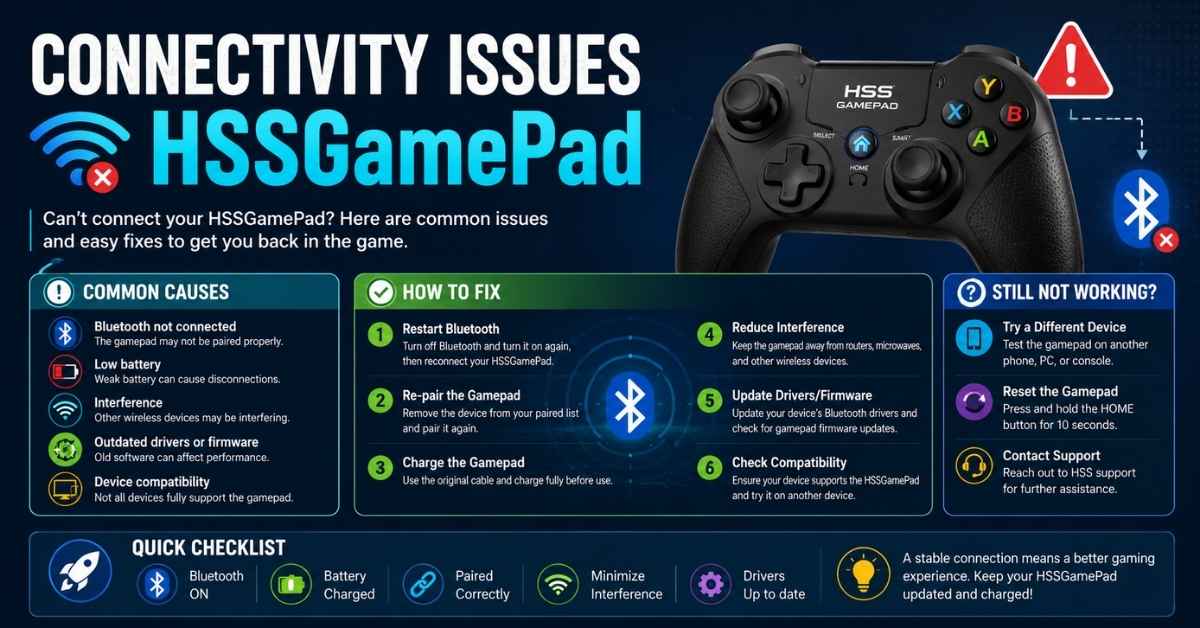
Connectivity issues HSSGamePad are usually caused by Bluetooth pairing failures, outdated drivers, low battery, firmware incompatibility, USB cable problems, or wireless interference. In most cases, you can fix the problem by re-pairing the controller, updating drivers or firmware, using a proper data USB cable, and eliminating signal interference. The key is to identify the exact symptom first instead of trying random fixes.
Whether your HSSGamePad won’t connect, keeps disconnecting, experiences input lag, or isn’t recognized by your PC or phone, this guide walks you through proven troubleshooting methods. You’ll also learn why these issues happen, how to prevent them in the future, and when the problem may indicate a hardware fault rather than a software issue.
Quick Symptom Checker
Before changing settings, identify what your controller is actually doing. This makes troubleshooting much faster.
| Problem | Most Likely Cause | Estimated Fix Time |
|---|---|---|
| Controller won’t connect | Bluetooth pairing issue | 2–5 minutes |
| Connected but buttons don’t work | Driver conflict | 5–10 minutes |
| Keeps disconnecting | Low battery or interference | 5–15 minutes |
| USB not detected | Faulty cable or USB port | 5–10 minutes |
| Noticeable input lag | Bluetooth congestion or outdated firmware | 10 minutes |
Once you know the symptom, you can apply the correct solution instead of wasting time on unnecessary troubleshooting.
Why HSSGamePad Connectivity Problems Happen
Understanding the root cause makes fixing the issue much easier. Most wireless controller problems fall into one of the following categories.
Bluetooth Pairing Problems
Bluetooth is the most common reason behind HSSGamePad connectivity issues. The controller may fail to enter pairing mode, another device may already be connected, or your computer’s Bluetooth adapter may have stored corrupted pairing information.
If your controller isn’t visible during Bluetooth scanning, removing old paired devices and pairing it again often resolves the problem.
USB Connection Issues
A surprising number of users unknowingly use a charging-only USB cable. While it charges the controller, it cannot transfer data, so Windows or Android never detects the device.
Also check:
- USB ports
- USB hubs
- Loose connectors
- Damaged cables
Using a certified data cable is always recommended for troubleshooting.
Outdated Drivers
On Windows, the Bluetooth driver or USB driver may become outdated after a system update.
When this happens:
- Windows cannot recognize the controller correctly.
- The controller connects but doesn’t respond.
- Random disconnects become more frequent.
Updating or reinstalling drivers often restores a stable connection.
Firmware Compatibility
Like many modern gaming accessories, HSSGamePad relies on firmware to communicate with different devices.
Older firmware versions can lead to:
- connection failures
- delayed input
- pairing errors
- compatibility issues after operating system updates
Keeping firmware current improves both stability and compatibility.
Low Battery
Many gamers overlook battery health.
A controller with a critically low battery may:
- disconnect unexpectedly
- struggle to maintain Bluetooth communication
- introduce noticeable latency
- fail during pairing
Always charge the controller fully before assuming there’s a hardware problem.
Wireless Interference
Bluetooth operates on the 2.4 GHz frequency, which is shared with many everyday devices.
Common sources of interference include:
- Wi-Fi routers
- Wireless headphones
- Bluetooth speakers
- Wireless keyboards
- Other game controllers
Too many nearby wireless devices can reduce connection stability and increase input delay.
Fix HSSGamePad Connectivity Issues Step by Step
Work through these fixes in order. They’re arranged from the quickest and simplest to more advanced solutions.
Step 1: Restart the Controller Properly
Many temporary software glitches disappear after a full restart.
Turn the controller off completely, wait about 30 seconds, and power it back on before trying to reconnect.
Although simple, this refreshes the controller’s internal Bluetooth processes.
Step 2: Fully Charge the Battery
Even if the battery indicator shows some charge, recharge the controller completely.
A stable power supply helps prevent:
- random disconnects
- pairing failures
- unstable wireless performance
If possible, leave it charging for at least one hour before testing again.
Step 3: Remove and Pair the Controller Again
Corrupted Bluetooth records are common after operating system updates or failed pairing attempts.
To refresh the connection:
- Open your device’s Bluetooth settings.
- Remove the existing HSSGamePad entry.
- Restart Bluetooth.
- Put the controller back into pairing mode.
- Connect it again as a new device.
This creates a fresh Bluetooth profile and often resolves persistent pairing issues.
Step 4: Test a Different USB Cable
If the controller isn’t recognized through USB, don’t assume it’s defective.
Instead:
- use another data-capable USB cable
- avoid cheap charging cables
- try another USB port
- avoid unpowered USB hubs
Many connectivity complaints are ultimately traced to faulty accessories rather than the controller itself.
Step 5: Restart Bluetooth Services
On Windows:
- Turn Bluetooth off.
- Wait 20 seconds.
- Turn it back on.
- Restart your computer if necessary.
This refreshes the Bluetooth stack, clears temporary communication errors, and allows the operating system to detect the controller again.
Step 6: Update Bluetooth and USB Drivers
Outdated drivers frequently cause controller disconnecting problems.
Open Device Manager and check for warning icons beside:
- Bluetooth adapters
- HID devices
- USB controllers
If updates are available, install them and restart your computer before testing the controller again.
Step 7: Check for Firmware Updates
If HSSGamePad provides firmware updates, install the latest version before continuing with advanced troubleshooting.
Firmware improvements often fix:
- pairing bugs
- compatibility issues
- wireless performance
- stability problems
Keeping firmware updated also improves long-term reliability.
Step 8: Reset the Controller
If none of the previous steps solve the problem, perform a complete controller reset.
A factory reset removes temporary software corruption and restores the default connection settings.
After resetting, pair the controller again from scratch instead of restoring previous Bluetooth settings.
Fix Connectivity Issues on Windows 10 and Windows 11
Windows is one of the most common platforms where users experience HSSGamePad not connecting problems. Fortunately, most issues are software-related and can be resolved without replacing the controller.
Remove Old Bluetooth Devices
Windows may attempt to reconnect using outdated Bluetooth profiles.
Open Bluetooth & Devices, remove old controller entries, and pair the controller again as a new device.
Check Device Manager
Open Device Manager and look for:
- Bluetooth adapters
- Human Interface Devices (HID)
- USB controllers
A yellow warning icon usually indicates a driver issue that needs attention.
Disable USB Power Saving
Windows sometimes turns off USB ports to save power, causing random controller disconnects.
Open the USB Root Hub properties and disable the option that allows Windows to turn off the device to save power.
This simple adjustment can significantly improve connection stability, especially during long gaming sessions.
Reinstall Bluetooth Drivers
If updating doesn’t help, uninstall the Bluetooth adapter from Device Manager, restart your PC, and allow Windows to reinstall the driver automatically.
A clean driver installation often resolves persistent communication errors and improves compatibility with wireless gaming controllers.
Fix Connectivity Issues on Android
Android devices generally support Bluetooth controllers well, but software settings can sometimes interfere with a stable connection.
Clear Bluetooth Cache
If your HSSGamePad Bluetooth connection keeps failing, clearing the Bluetooth cache can remove corrupted connection data.
- Open Settings.
- Go to Apps.
- Find Bluetooth (or Bluetooth system service).
- Clear the cache.
- Restart your phone and pair the controller again.
Disable Battery Optimization
Some Android devices aggressively manage background Bluetooth services.
To prevent unexpected disconnects:
- Open Battery Settings.
- Disable battery optimization for Bluetooth (if available).
- Restart the controller.
This helps maintain a more stable wireless connection during long gaming sessions.
Pair the Controller Again
If your phone still doesn’t recognize the controller:
- Forget the paired device.
- Turn Bluetooth off and on.
- Put the controller into pairing mode.
- Connect it as a new device.
This refreshes the Bluetooth profile and often fixes pairing failures.
Fix Connectivity Issues on iPhone and iPad
Apple devices support compatible Bluetooth controllers, but pairing issues may still occur.
Check Compatibility
Before troubleshooting, confirm that your iPhone or iPad supports external game controllers and that your HSSGamePad is compatible with your iOS version.
Reset Bluetooth Connections
Remove the controller from Bluetooth Settings, restart the device, and pair it again.
This often resolves connection errors caused by outdated pairing information.
Update iOS
Running an outdated version of iOS may create compatibility issues with Bluetooth accessories.
Installing the latest software update can improve Bluetooth stability and controller support.
Why Your HSSGamePad Keeps Disconnecting During Gameplay
Random disconnects are frustrating, especially during competitive matches. These are the most common causes.
Weak Bluetooth Signal
Walls, desks, and long distances reduce signal quality.
Keep the controller within a reasonable range of the connected device for better connection stability.
Low Battery Voltage
Even when the battery isn’t fully depleted, insufficient voltage can interrupt Bluetooth communication.
Recharge the controller before long gaming sessions.
Too Many Connected Devices
Multiple Bluetooth devices compete for bandwidth.
Disconnect unused:
- Wireless headphones
- Speakers
- Keyboards
- Other controllers
Reducing Bluetooth traffic can improve responsiveness.
Wireless Interference
Nearby Wi-Fi routers, wireless cameras, and other 2.4 GHz devices may interfere with Bluetooth signals.
Whenever possible:
- Move away from the router.
- Reduce nearby wireless devices.
- Switch to a USB connection for critical gaming sessions.
Power Management Settings
Windows power-saving features may disable Bluetooth or USB devices to conserve energy.
Changing these settings often eliminates unexpected disconnects.
How to Fix Input Lag and Delayed Button Response
Input lag is usually caused by communication delays rather than controller hardware.
Reduce Wireless Interference
Keep unnecessary Bluetooth devices disconnected while gaming.
A cleaner wireless environment reduces latency.
Use a Wired USB Connection
If you’re playing competitive games, a USB data connection generally provides a more stable experience than Bluetooth.
Close Background Bluetooth Connections
Devices continuously searching for Bluetooth connections can increase latency.
Disconnect accessories you aren’t actively using.
Keep Firmware Updated
Manufacturers often improve connection stability and responsiveness through firmware updates.
If updates are available, install them before troubleshooting further.
Advanced Troubleshooting for Persistent Problems
If basic fixes haven’t solved the issue, move on to more advanced diagnostics.
Perform a Complete Bluetooth Reset
Remove every stored controller profile from your device.
Restart Bluetooth.
Pair the HSSGamePad again from scratch.
Reinstall Device Drivers
On Windows, uninstall the Bluetooth adapter or HID device from Device Manager and restart the computer.
Windows will automatically reinstall the required drivers.
Test the Controller on Another Device
Connect the controller to another:
- PC
- Android phone
- Tablet
If it works correctly elsewhere, the original device is likely causing the issue.
Check for Physical Damage
Inspect the controller for:
- loose USB ports
- damaged buttons
- cracked casing
- signs of moisture
- swollen battery
Physical damage may require repair or replacement.
Determine Whether the Problem Is Hardware or Software
Use this simple checklist:
| Symptom | Likely Cause |
|---|---|
| Doesn’t work on any device | Hardware issue |
| Works on another device | Software or driver issue |
| Disconnects only through Bluetooth | Wireless interference or Bluetooth settings |
| USB works but Bluetooth doesn’t | Bluetooth hardware or software problem |
Common HSSGamePad Problems and Their Solutions
| Problem | Recommended Solution |
|---|---|
| Controller won’t connect | Pair again after removing old Bluetooth profile |
| USB not detected | Use a proper data cable and another USB port |
| Keeps disconnecting | Recharge battery and reduce wireless interference |
| Connected but buttons don’t respond | Reinstall drivers and reconnect |
| Input lag | Update firmware or switch to USB |
Mistakes That Make Connectivity Problems Worse
Avoid these common errors:
- Repeatedly pairing without deleting old Bluetooth records.
- Using charging-only USB cables.
- Ignoring firmware updates.
- Keeping dozens of Bluetooth devices connected simultaneously.
- Assuming the controller is defective before testing it on another device.
Small mistakes often create larger connection problems.
Prevent Future Connectivity Issues
Good maintenance significantly reduces future troubleshooting.
Keep Firmware Updated
Install updates whenever available to improve compatibility and stability.
Maintain Battery Health
Avoid storing the controller with a completely discharged battery for long periods.
Recharge it regularly.
Reduce Wireless Interference
Keep your gaming area free from unnecessary Bluetooth devices whenever possible.
Clean USB Ports
Dust and debris inside USB connectors can interrupt data transmission.
Cleaning ports periodically helps maintain reliable connections.
Store the Controller Properly
Protect the controller from moisture, excessive heat, and accidental drops.
Proper storage extends both battery life and overall durability.
When Should You Repair or Replace Your HSSGamePad?
Most connectivity issues HSSGamePad users experience are software-related and can be fixed using the steps above.
However, replacement may be necessary if:
- the controller isn’t detected on any device
- USB and Bluetooth both fail consistently
- the battery no longer holds a charge
- internal hardware has been damaged
- physical buttons or ports are broken
Testing the controller on multiple compatible devices is the easiest way to determine whether the problem lies with the controller or your system.
LEARN MORE: Connectivity HSSGamepad
Expert Tips for a Stable Connection
Following these best practices can prevent many future problems:
- Keep your operating system updated.
- Use a high-quality USB data cable.
- Avoid crowded Bluetooth environments.
- Pair the controller only with devices you regularly use.
- Restart Bluetooth occasionally after major system updates.
- Check battery levels before long gaming sessions.
- Remove old paired devices you no longer use.
These habits improve long-term reliability and reduce unexpected connection failures.
Frequently Asked Questions
Why won’t my HSSGamePad connect even after pairing?
This usually indicates a driver conflict, outdated Bluetooth profile, or firmware compatibility issue. Remove the existing pairing, restart Bluetooth, and reconnect the controller as a new device.
Can a low battery cause Bluetooth connectivity issues?
Yes. A weak battery can reduce Bluetooth stability, resulting in random disconnects, delayed input, or failed pairing.
Why does my controller connect but not respond?
The controller may be connected through Bluetooth, but outdated drivers, compatibility issues, or incorrect controller settings can prevent button input from being recognized.
Is USB better than Bluetooth?
For competitive gaming, USB generally provides lower latency and a more stable connection, while Bluetooth offers greater convenience for casual play.
How do I know if my HSSGamePad is defective?
If the controller fails to connect on multiple compatible devices after completing all troubleshooting steps, it may have a hardware fault that requires repair or replacement.
Conclusion
Most connectivity issues HSSGamePad users encounter stem from Bluetooth pairing problems, outdated drivers, firmware mismatches, low battery levels, USB cable issues, or wireless interference rather than a faulty controller. By identifying the exact symptom first and following a structured troubleshooting process, you can usually restore a stable connection within minutes.
Start with the simplest fixes—recharge the controller, re-pair it, test a different USB data cable, and update your drivers or firmware. If the problem persists, move on to advanced diagnostics to determine whether you’re dealing with a software conflict or a genuine hardware failure. Taking a methodical approach not only saves time but also helps you avoid replacing a controller that can often be fixed with a few practical adjustments.